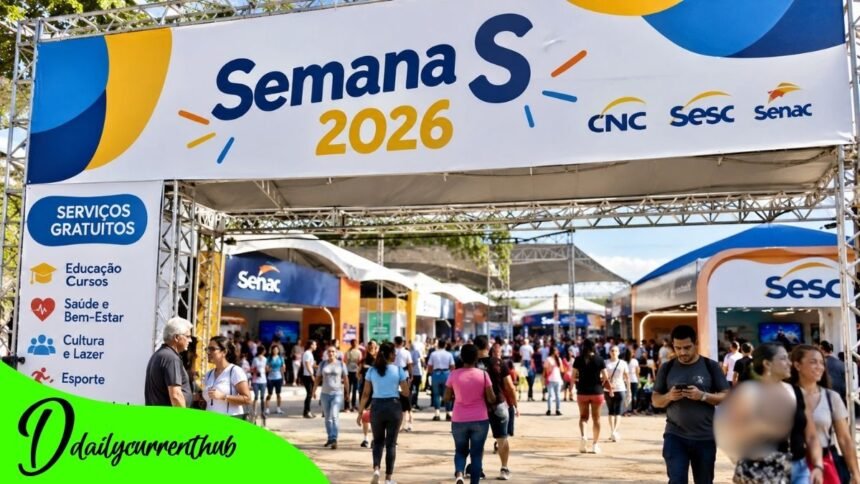
Semana S 2026 brought together millions of people across Brazil through a nationwide program of education, healthcare, professional development, culture, sports, and community services. Organized by the Sistema Comércio, the initiative demonstrated how institutions serving the commercial and service sectors can also deliver direct benefits to the wider population.
The central national program took place on May 15 and 16, 2026, with some regional activities extending across additional days. Events were held in all 26 Brazilian states and the Federal District, connecting major cities and smaller communities through accessible public activities.
According to the organizers’ official reports, the second edition generated more than 3 million attendances, combining services delivered through Sesc and Senac.
Beyond its impressive participation figures, the event provided opportunities for professional training, preventive healthcare, cultural participation, and community support.
This article explores the history, organization, activities, verified achievements, and broader significance of Semana S 2026, showing how the initiative strengthened connections between Brazilian businesses, workers, and communities.
What Is Semana S 2026?
Semana S 2026 was a coordinated national initiative designed to introduce more Brazilians to the services and programs supported by the country’s commercial sector.
The name refers to a movement involving major institutions within Brazil’s Sistema Comércio, especially Sesc and Senac. These organizations work in different but complementary areas, including social well-being, educational development, and professional qualification.
Unlike an ordinary trade exhibition, Semana S combined business-related opportunities with public services and entertainment. Families could attend cultural performances, workers could explore professional courses, and community members could participate in health and recreational activities.
The event also gave entrepreneurs opportunities to learn about business development and services relevant to commercial operations.
Its distinctive feature was combining these experiences within one nationally coordinated program. Although schedules differed across states, the activities shared a broader objective: making the work of participating institutions more accessible and visible to Brazilian society.
Origins and Background of Semana S
The nationwide Semana S initiative began in 2025 and established a coordinated public program for institutions in commerce, services, and tourism.
Its first edition reportedly attracted more than one million participants across Brazil. Senac delivered approximately 251,000 attendees, while food donation initiatives collected around 121 tonnes of supplies.
These early results established a foundation for expansion in 2026.
Rather than introducing an entirely new set of public institutions, Semana S brought together organizations that were already active in professional training, social development, and community services.
This approach allowed it to introduce existing institutional programs to larger audiences through coordinated events, publicity, and local partnerships.
The second edition built on this foundation with expanded programming, broader public participation, and a substantial increase in recorded services.
Dates and Nationwide Locations
The main national activities of Semana S 2026 were scheduled for May 15 and 16, though regional calendars differed.
In Rio Grande do Norte, for example, organizers announced activities from May 9 to 16. In Minas Gerais, the Belo Horizonte program ran from May 11 to 17.
The national initiative reached all Brazilian states and the Federal District, with activities in capital cities and selected municipalities.
Public squares, educational institutions, cultural facilities, and participating Sesc and Senac units provided venues for the program.
This geographic distribution made Semana S more than a single-city event. Local organizers could adapt their schedules and activities to their communities while participating in the wider national initiative.
Organizers and Their Responsibilities
Semana S 2026 was coordinated nationally by the Confederação Nacional do Comércio de Bens, Serviços e Turismo (CNC), working with state-level commercial federations, business unions, Sesc, and Senac.
These institutions contributed different capabilities.
Sesc, the Social Service of Commerce, concentrated on areas such as health, culture, recreation, sports, and social assistance.
Senac, the National Commercial Training Service, emphasized professional education, practical workshops, and career development.
The Fecomércios and participating business organizations supported regional coordination and engagement with the commercial sector.
Their collaboration allowed the national event to combine services that ordinarily operate through separate programs.
Education and Professional Training Opportunities
Professional education was one of Semana S 2026’s strongest features.
Senac publicized more than 50,000 free course places connected with the event, covering sectors including technology, gastronomy, tourism, healthcare, and management.
The educational activities included workshops, practical demonstrations, and opportunities to discover different occupational fields.
These experiences were especially relevant to students, employees seeking new skills, entrepreneurs, and people considering career changes.
Practical participation offered a different experience from simply reading about a course. Visitors could observe training methods, learn about available educational pathways, and interact with professionals.
National figures subsequently recorded 616,016 Senac attendances during the 2026 initiative.
The figure demonstrates the scale of engagement, although participation in an event activity should not automatically be interpreted as completing a qualification or securing employment.
Healthcare and Community Services
Health and well-being formed another major component of the program.
Participating Sesc and Senac facilities organized preventive healthcare activities, wellness services, and public educational experiences.
Services varied by region.
For example, Senac Sergipe reported activities involving blood pressure checks, blood glucose measurements, massage, and other health-related demonstrations.
These services were offered alongside beauty, gastronomy, and educational activities, giving visitors opportunities to engage in different forms of public participation in a shared setting.
The approach connected preventive health education with broader community participation.
At the national level, Sesc reported approximately 2.46 million attendances, reflecting its extensive involvement across the country.
Music, Culture, and Entertainment
Cultural programming was among the most visible aspects of Semana S 2026.
Official Sesc reports identified more than 60 free musical performances across Brazil.
Artists included Gloria Groove, Luísa Sonza, Ana Castela, Michel Teló, Solange Almeida, Fresno, and Mestrinho, with performances distributed among different states.
In Rio de Janeiro, Gloria Groove performed at Praça Mauá. Luísa Sonza was a featured attraction in the Federal District, while other artists participated in regional programs.
These concerts introduced entertainment into an initiative otherwise strongly associated with education and public services.
Music also brought attention to the wider program, encouraging audiences to discover participating institutions and their activities.
The cultural component demonstrated that public engagement can combine recreational experiences with educational and social initiatives.
Sports and Family Participation
Sport played a substantial role in the event, particularly through the Circuito Sesc de Corridas.
The circuit coincided with the celebration of Sesc’s 80th anniversary in 2026.
According to the institution’s national report, more than 35,500 participants joined the running initiative. During the main weekend, 30 stages were held simultaneously in different parts of Brazil.
Activities accommodated different groups, including recreational runners, experienced athletes, children, and participants with disabilities.
Sports programming complemented cultural performances, educational workshops, and family-friendly recreation.
This variety mattered because the event did not rely on a single audience. People with different ages, interests, and professional backgrounds could participate in activities relevant to them.
Social Responsibility and Food Donations
One of the clearest measures of Semana S 2026’s community contribution was its support for Sesc Mesa Brasil.
The program addresses food insecurity and food waste by directing donations to organizations serving vulnerable communities.
During Semana S 2026, food collection campaigns and solidarity-based registration initiatives helped collect more than 249.6 tonnes of food.
This result exceeded the approximately 121 tonnes reported during the 2025 edition.
The food collection activity connected public participation with practical social assistance.
Rather than treating entertainment, sports, and community support as separate concerns, organizers incorporated charitable collections into the wider program.
The initiative also showed how large public events can give charitable organizations opportunities to engage new supporters and expand awareness of their services.
National Results and Regional Achievements
The national results provide a measurable picture of the second edition’s scale.
According to figures reported by Senac Rondônia from the CNC’s official assessment, Sesc recorded 2,464,132 attendances, while Senac recorded 616,016.
Together, these institutional figures exceed three million. They reflect reported activity and service participation, not necessarily three million different individuals.
Regional outcomes illustrate how the nationwide framework operated locally.
In Rondônia, participating institutions reported approximately 32,000 attendances and offered 69 different services. Organizers also recorded participation from hundreds of entrepreneurs.
In Maranhão, the integrated program reported 25,975 attendances and extended beyond São Luís into nine other municipalities.
These examples demonstrate that the initiative’s influence was not restricted to large metropolitan areas.
They also clarify the national figures by showing how participation was distributed across local services, business activities, and educational opportunities.
Legacy and Future of Semana S
The 2026 edition established a significantly larger reported reach than the inaugural national program.
Its results give organizers practical evidence of public demand for coordinated education, healthcare, cultural, and community initiatives.
Large attendance figures alone cannot establish long-term social or economic outcomes. Measuring those effects would require additional information about course completion, employment, continuing service use, and the distribution of community assistance.
Nevertheless, the documented participation, training opportunities, sports involvement, cultural events, and food collections demonstrate the scope of the program.
The official Semana S website has also confirmed plans for another edition in 2027, although future programming and locations should be checked against announcements from the organizers.
Conclusion
Semana S 2026 demonstrated the scale of coordinated public engagement through Brazil’s Sistema Comércio. Bringing together CNC, Sesc, Senac, commercial federations, and business organizations, the event delivered an extensive program of education, culture, health, recreation, and social assistance.
Its second edition reached more than three million recorded attendances nationwide, while professional education, sporting activities, and food donation campaigns produced further measurable results.
The event’s significance extended beyond its attendance figures. It gave communities opportunities to interact with institutions whose services support workers, families, entrepreneurs, and people seeking professional development.
The 2026 program also established a documented foundation for the initiative’s next edition.
Ultimately, Semana S illustrated how nationally coordinated organizations can combine local action with a shared public purpose, connecting professional development and community well-being through accessible events across Brazil.
(FAQs)
1. What was Semana S 2026?
Semana S 2026 was a nationwide Brazilian event featuring free educational, healthcare, cultural, sporting, and community activities organized by institutions within the Sistema Comércio.
2. When did Semana S 2026 take place?
The central national program took place on May 15 and 16, 2026. Some states organized additional activities on surrounding dates.
3. Who organized Semana S 2026?
The event was nationally coordinated by the CNC, with participation from Sesc, Senac, Fecomércios, and business unions.
4. Was Semana S 2026 free to attend?
The event featured free public activities. Certain programs required advance registration, and some locations applied specific participation conditions.
5. How many people participated in Semana S 2026?
Organizers reported more than three million attendees nationwide, combining activities delivered by Sesc and Senac.
6. Did Semana S 2026 offer professional courses?
Yes. Senac announced more than 50,000 free course places covering several professional fields, including technology, management, tourism, and gastronomy.
7. What were the biggest highlights of Semana S 2026?
Major highlights included free concerts, professional workshops, health activities, a national running circuit, and substantial food donations through Sesc Mesa Brasil.
8. Will Semana S return in 2027?
Yes. The official event website has announced that Semana S will return in 2027, with further details to be provided through official channels.