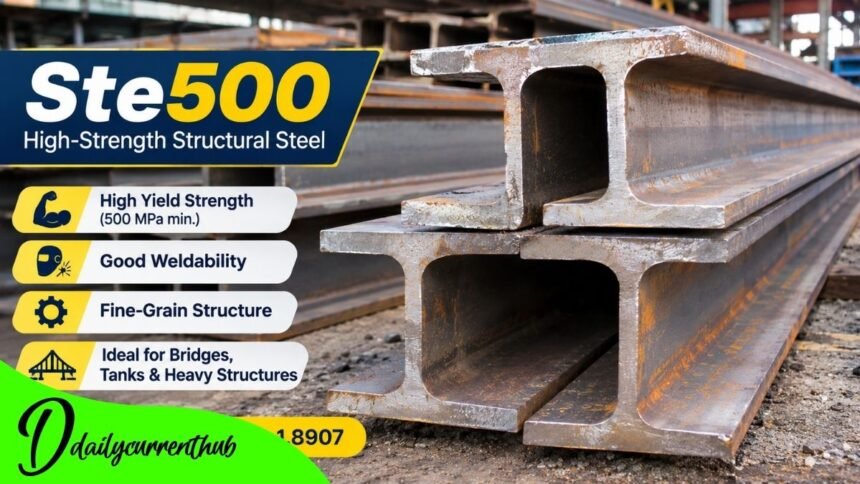
A comprehensive look at StE500 structural steel, its mechanical strength, chemical composition, industrial applications, welding requirements, and modern material standards.
StE500, also written as StE500 or StE 500, is a high-strength structural steel grade associated with the German DIN 17102 specification. Developed for demanding engineering applications, this fine-grain steel combines substantial mechanical strength with properties suitable for welded construction.
Engineers and material specialists encounter StE500 in technical documentation involving industrial structures, storage tanks, bridges, and other load-bearing components. Its historical importance comes from its mechanical specifications and the role of DIN standards in European steel engineering.
Although DIN 17102 has been withdrawn, its material designations may still appear in older engineering drawings, equipment records, and procurement documents.
This article examines Ste500 through its verified material designation, mechanical properties, manufacturing characteristics, typical applications, welding considerations, and relationship with modern European steel standards.
Quick Facts About Ste500
FieldDetails
Material Name StE 500
Common Search Term Ste500
Material Number 1.8907
Material Category Fine-grain structural steel
Original Standard DIN 17102
Country of Standard Origin Germany
Minimum Yield Strength 500 MPa for thickness up to 16 mm
Tensile Strength Approximately 610–780 MPa for thickness up to 70 mm
Key Characteristic High strength and suitability for welded construction
Typical Applications Bridges, storage tanks, structural supports, and industrial equipment
Historical Standard Status Withdrawn
Direct EN Equivalent No direct designation established in EN 10025-3:2019
What Is Ste500?
Ste500 is a fine-grain, high-strength structural steel identified by material number 1.8907 under the historical German DIN 17102 specification.
The steel belongs to a category of materials developed for applications requiring substantial load-bearing capacity and controlled mechanical properties.
The number 500 refers to the specified minimum yield strength of 500 megapascals for material thicknesses up to 16 millimeters. Yield strength measures the stress at which a material begins to undergo permanent plastic deformation.
A higher yield-strength specification can help engineers design structural components that resist greater mechanical stresses, provided other design requirements are met.
StE500 is particularly relevant to welded engineering structures. Its specified mechanical characteristics make it a practical material for various industrial applications.
However, steel selection requires more than identifying yield strength. Engineers must also evaluate toughness, thickness, weldability, operating temperature, and the applicable construction standards.
Historical Background of Ste500
StE500 originated within the German system of engineering material specifications.
DIN 17102 established requirements for weldable fine-grain structural steels. These materials were intended for industrial structures that required predictable mechanical properties.
The 1983 edition of DIN 17102 identified StE500 under material number 1.8907.
European standardization later introduced newer systems for classifying structural steels. Standards such as EN 10025-3 and EN 10028-3 became relevant to different categories of structural and pressure-equipment materials.
The withdrawal of DIN 17102 did not eliminate historical material references from existing engineering documentation.
Older construction drawings, replacement-part specifications, and technical records may continue to identify components by their original steel grades.
For this reason, understanding StE500 remains useful when assessing legacy equipment or considering material replacements.
Mechanical Properties of StE500
Mechanical performance is a defining characteristic of this steel grade.
Yield Strength
For products up to 16 mm thick, historical StE500 specifications identify a minimum yield strength of 500 MPa.
The specified minimum decreases as product thickness increases.
Representative published values include:
Material Thickness Minimum Yield Strength
Up to 16 mm 500 MPa
Over 16–35 mm 480 MPa
Over 35–50 mm 470 MPa
Over 50–60 mm 460 MPa
Over 60–70 mm 450 MPa
These thickness-dependent differences matter when engineers calculate the load-bearing capacity of steel components.
A material’s nominal grade designation should never replace the actual mechanical requirements for the thickness being used.
Tensile Strength
Tensile strength describes the maximum engineering stress a material can withstand during a tensile test before fracture-related failure develops.
Published StE500 data indicate a tensile-strength range of approximately 610–780 MPa for material thicknesses up to 70 mm.
The specified range changes for thicker products.
Combining yield strength and tensile strength helps engineers evaluate structural performance under different loading conditions.
Ductility and Toughness
Strength alone does not establish whether a material is suitable for a particular application.
Ductility describes steel’s ability to undergo plastic deformation before fracture.
Toughness relates to the energy a material can absorb before fracturing.
Both properties are significant in welded structures, particularly where impact loading, stress concentrations, or lower operating temperatures are involved.
Chemical Composition of Ste500
The mechanical properties of structural steel depend partly on its chemical composition and manufacturing process.
StE500 contains iron as its principal constituent, together with controlled amounts of alloying elements.
Carbon and Manganese
Carbon contributes to steel strength, but excessive carbon can increase hardness and complicate welding.
Published historical-grade compositions commonly identify a maximum carbon content of approximately 0.21%.
Manganese contributes to strength and helps influence the steel’s mechanical characteristics.
Published supplier specifications describe manganese contents around 1.00–1.70%, although the exact applicable requirements must be confirmed against the governing material specification.
Other Alloying Elements
Silicon, aluminum, niobium, and vanadium may contribute to the properties of fine-grain structural steels.
Some alloying elements help refine the grain, while others influence strength, deoxidation, or manufacturing behavior.
Phosphorus and sulfur are controlled because excessive concentrations can adversely affect material quality and performance.
A certified chemical analysis is needed to confirm the composition of an actual steel batch.
Manufacturing and Heat Treatment
The manufacturing condition of structural steel influences its final mechanical properties.
StE500 is associated with normalized fine-grain steel production.
Normalizing is a heat-treatment process that involves heating steel to an appropriate temperature and then cooling it under controlled conditions, typically in air.
The process can help establish a suitable microstructure and mechanical characteristics.
The term fine-grain describes a controlled metallurgical structure associated with improved combinations of strength and toughness.
Manufacturing conditions should be checked against the original specification and purchase documentation.
A steel product cannot be assumed to meet StE500 requirements simply because it has undergone heat treatment or demonstrates high strength in one test.
Welding Characteristics of StE500
Weldability is an important consideration when selecting steel for industrial construction.
StE500 was specified for welded applications, but successful fabrication depends on appropriate welding procedures.
Several factors influence welded-joint performance.
These include base-metal composition, material thickness, hydrogen control, welding consumables, heat input, and cooling conditions.
The heat-affected zone around a weld can develop mechanical properties different from the unaffected parent material.
For high-strength steel, improper welding conditions may increase the risk of cracking or undesirable changes in hardness and toughness.
Engineers therefore use qualified welding procedures rather than relying solely on the material designation.
Depending on the application, welding qualification, preheat assessment, nondestructive testing, and appropriate inspection may be necessary.
Industrial Applications of Ste500
The historical material designation appears in connection with several engineering applications.
Bridges and Structural Supports
Bridge structures require materials that can carry significant loads while maintaining appropriate resistance to deformation and fracture.
High-strength fine-grain steels can be useful where structural efficiency is a design objective.
StE500 has been identified in technical references as a material used for bridge and support construction.
However, the appropriate grade depends on the specific structural design and applicable regulations.
Storage Tanks and Pressure Equipment
Material databases also associate StE500 with stationary and mobile storage tanks, pressure vessels, and high-pressure lines.
These applications place particular importance on material traceability, mechanical performance, and operating conditions.
Pressure-equipment construction also requires compliance with the relevant design code.
Historical material use does not automatically approve a new pressure vessel.
Heavy Industrial Machinery
Industrial machinery frequently incorporates welded frames, supports, and load-bearing assemblies.
A high-strength steel grade may help satisfy structural requirements without relying entirely on increased component thickness.
The actual benefit depends on factors such as stiffness, fatigue resistance, stability, fabrication constraints, and operating loads.
For this reason, material selection must form part of the complete engineering design.
Ste500 and Modern European Steel Standards
One of the most important questions concerns the relationship between StE500 and newer European grades.
DIN 17102 is a withdrawn standard, while EN 10025-3 provides requirements for several modern normalized or normalized-rolled structural steel grades.
The 2019 edition of EN 10025-3 identifies S275, S355, S420, and S460 grades.
It does not establish an S500N grade within that specification.
A TÜV-Verband material classification document also identifies historical StE500, material number 1.8907, as a grade not carried into an EN standard under a direct designation.
This distinction matters because some commercial material-comparison pages describe S500N as a direct successor to StE500.
Such claims should not be accepted without checking the applicable standard.
S460N is another recognized structural steel grade, but its specified minimum yield strength is lower than StE500’s 500 MPa requirement for thin products.
Consequently, S460N should not automatically be treated as a direct replacement.
A qualified engineer must compare all required mechanical, chemical, fabrication, and service properties before approving an alternative material.
How to Identify Genuine Ste500 Material
Accurate material identification is essential during procurement and equipment maintenance.
A supplier description alone may not provide sufficient evidence of compliance.
Engineers and purchasing specialists generally examine several documents and material characteristics.
These include:
- The stated steel designation and material number.
- The edition of the original material specification.
- Product dimensions and thickness.
- Chemical analysis results.
- Mechanical test results.
- Manufacturing and heat-treatment conditions.
- Material traceability records.
Inspection documentation is particularly important for projects requiring certified material properties.
Under EN 10204, inspection certificates such as types 3.1 and 3.2 provide different levels of verification and inspection involvement.
The appropriate documentation depends on contractual requirements, regulations, and the intended use.
Common Misconceptions About Ste500
A frequent misunderstanding is that the number 500 guarantees a yield strength of 500 MPa for every product thickness.
Historical data show that minimum yield strength changes with thickness.
Another misconception is that all high-strength steels can be substituted for one another.
Even when two materials share similar tensile properties, their chemistry, toughness, heat-treatment condition, and welding behavior may differ.
A third misunderstanding concerns modern standards.
The withdrawal of DIN 17102 does not mean every historical grade has a direct one-to-one equivalent in current European specifications.
Finally, high strength does not eliminate the need to assess fatigue performance, corrosion exposure, or service-temperature limitations.
Engineers must evaluate these characteristics separately during design.
The Continuing Relevance of Ste500
StE500 remains significant as a historical material designation rather than a newly standardized European structural steel grade.
Its importance is particularly evident in industrial maintenance and engineering projects involving older drawings or equipment.
When replacement components are required, understanding the original material designation helps define the performance requirements an alternative must meet.
Material traceability also supports more reliable inspection and maintenance decisions.
Modern engineering standards provide additional material options, but selecting an alternative requires careful technical assessment.
The continuing appearance of StE500 in technical documentation demonstrates why historical steel grades remain relevant to contemporary engineering work.
Conclusion
Ste500 is a high-strength, fine-grain structural steel grade historically defined under DIN 17102 and identified by material number 1.8907.
Its mechanical properties, including a minimum yield strength of 500 MPa for products up to 16 mm thick, made it suitable for demanding welded construction applications.
The material has been associated with bridges, structural supports, storage tanks, and industrial engineering equipment.
Although DIN 17102 has been withdrawn, StE500 still appears in historical specifications and technical documentation.
Understanding its properties is important when reviewing legacy designs, purchasing replacement materials, or evaluating alternatives.
The most important consideration is that similar-looking material designations do not guarantee equivalent performance. Every proposed replacement must be assessed against the applicable technical requirements.
(FAQs)
1. What is Ste500?
Ste500 is a high-strength, fine-grain structural steel grade originally specified under the German DIN 17102 standard.
2. What is the material number of Ste500?
The material number is 1.8907.
3. What is the yield strength of Ste500?
Its specified minimum yield strength is 500 MPa for products up to 16 mm thick. The minimum decreases for greater thicknesses.
4. Is Ste500 suitable for welding?
StE500 was developed for welded construction, but welding must follow appropriate procedures that account for material thickness, composition, and application requirements.
5. Where is Ste500 used?
Historical technical references associate the grade with bridges, structural supports, storage tanks, pressure equipment, and other welded industrial structures.
6. Is Ste500 the same as S460N?
No. S460N is a different steel grade with its own mechanical requirements. It cannot automatically replace Ste500.
7. Does Ste500 have a direct modern EN equivalent?
A direct replacement designation is not established in EN 10025-3:2019. Any proposed substitute requires engineering verification.
8. Why is Ste500 still relevant today?
The designation may appear in legacy engineering drawings, equipment records, material certificates, and replacement-part specifications.