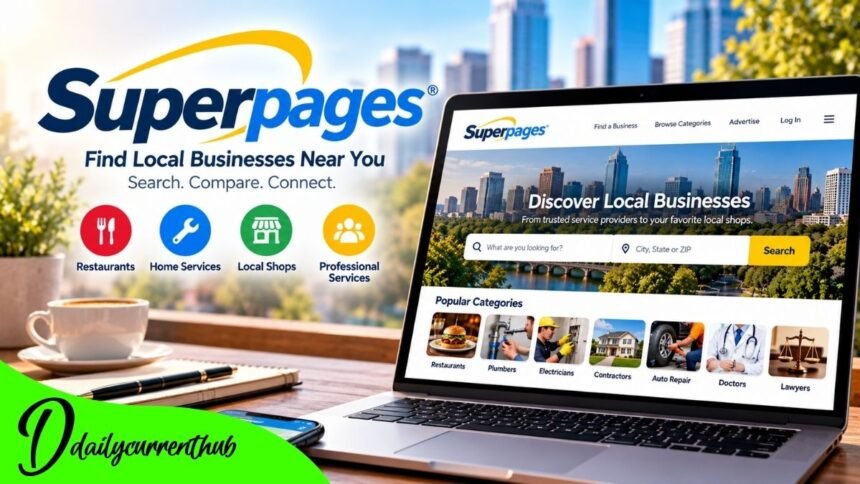
Superpages is an American online business directory that connects consumers with businesses, professionals, and local service providers. Rather than a private individual associated with a public figure, Superpages is a business discovery platform rooted in the traditional Yellow Pages directory industry.
The platform lets people search for businesses by category, service, and location. Listings can include contact details, addresses, business descriptions, and other information that helps users choose a local provider.
For businesses, directory platforms represent another way to establish an online presence beyond their own websites. For consumers, they offer a convenient starting point when searching for restaurants, contractors, automotive services, healthcare providers and other local businesses.
This guide examines Superpages’ background, how its directory works, its relevance to local search engine optimization (SEO), and the practical considerations businesses and consumers should understand before relying on directory information.
What Is Superpages?
Superpages is a digital directory designed to help people locate businesses and services in particular geographic areas. Its central function is straightforward: users enter what they need and where they need it, then explore relevant business listings.
For example, someone looking for an electrician in Chicago can search by service category and city. The directory presents matching businesses, helping the person identify potential providers without already knowing their names.
The official website features categories including plumbers, electricians, restaurants, lawyers, mechanics and contractors. It also lets businesses manage their listings.
Unlike a general social media platform, Superpages is organized around commercial discovery. It connects a consumer’s immediate need with businesses that can meet it.
That distinction makes it particularly relevant to local service providers, whose customers frequently search by location, availability and type of work.
History and Background of Superpages
Superpages’ history is closely tied to the development of American telephone directories and the shift from printed Yellow Pages to internet-based business search.
Traditional directories organized commercial information into categories so residents could locate nearby services. The digital model expanded that concept by making listings searchable through websites rather than requiring consumers to consult printed books.
Superpages became part of this broader transition, combining business information with opportunities for internet advertising.
Historical filings with the US Securities and Exchange Commission document Superpages as an established online directory offering basic business listings and paid advertising enhancements.
The business later became associated with Thryv, a company that offers digital marketing, business software, and directory advertising.
Thryv has identified Superpages.com, Yellowpages.com and Dexknows.com among its proprietary business search properties.
This history explains why Superpages resembles a traditional directory while operating in a modern digital environment. Its underlying purpose has remained consistent: making commercial information accessible to people searching for local services.
How Superpages Works for Consumers
The search experience starts with two key pieces of information: the service needed and the relevant location.
A visitor might search for roofing contractors, automotive repairs, dental practices, or accounting services. Adding a city or other geographic reference helps narrow the results.
The website’s search structure lets users discover businesses through categories rather than individual company names.
This is useful when a consumer hasn’t yet chosen a provider. Instead of visiting several unrelated websites, the person can begin with a collection of potentially relevant businesses.
A directory listing may provide practical details such as a telephone number, address, website and description of the services offered.
The completeness of that information varies between businesses. Some listings contain substantial details, while others may offer only basic contact information.
Consumers should therefore treat the directory as a discovery resource rather than a guarantee of service quality.
Checking a company’s website, confirming its contact information, and reviewing relevant professional credentials can help you make a better decision.
Business Listings and Local Search Visibility
For small businesses, online discoverability is key to attracting customers.
A local company may have a professionally designed website but still benefit from appearing in relevant third-party directories.
Superpages offers another location where potential customers can encounter a business name, contact details, and service information.
Consider a plumbing company serving several neighborhoods. Its website explains its services, but a directory profile gives someone searching by trade and location another chance to discover the company.
This does not mean that inclusion guarantees more customers or higher search rankings. A listing’s value depends on factors such as relevance, accuracy, visibility, and whether consumers use the platform for that service.
A complete profile can still make discovery easier.
For businesses without sophisticated marketing resources, maintaining accurate directory information is a practical task that can be managed alongside other local marketing activities.
How to Claim or Update a Superpages Business Listing
The official Superpages website provides business listing management options and a process for requesting corrections.
Business owners should begin by searching for their existing company listing. This helps you determine whether the business already appears in the directory and whether the details shown are accurate.
Superpages’ published instructions describe an editing process through the business profile page.
Step 1: Search for your business on Superpages.
Step 2: Open the profile and select the available listing management or “Suggest an Edit” option.
Step 3: Submit the corrected business information.
Step 4: Allow the platform’s data quality team to review the requested changes.
Superpages states that its data quality team verifies submitted corrections before updating business profiles.
Business owners should use accurate company names, genuine addresses, and current contact details. Misleading descriptions, unrelated categories, and unnecessary keyword repetition can undermine a listing’s usefulness.
Superpages and Local SEO
Local search engine optimization helps a business become discoverable when consumers search for services in a particular geographic area.
Business directories support this broader strategy by publishing consistent business information across the internet.
One commonly discussed element of local SEO is NAP consistency, referring to the accuracy and consistency of a business’s name, address, and phone number.
If a company uses different telephone numbers or outdated addresses across directories, consumers may struggle to determine which information is correct.
Consistent details reduce confusion and support a more coherent online business presence.
Thryv’s listing management documentation explains how to distribute business information to connected directories and manage details such as contact information, operating hours, and service categories.
However, a Superpages listing should not be presented as a guaranteed Google ranking factor or a shortcut to first-page visibility.
Search performance depends on many factors, and a directory profile alone cannot guarantee additional organic traffic.
The strongest approach is to maintain a useful business website, accurate directory profiles, and relevant information that genuinely serves customers.
Reviews, Ratings and Consumer Trust
Online reviews can influence how consumers evaluate unfamiliar businesses, particularly when several providers offer similar services.
Directory advertising documentation associated with Thryv identifies ratings and reviews among the types of information that business profiles may contain. The availability of individual fields can vary.
Reviews are most useful when interpreted carefully, not treated as definitive proof of quality.
For example, a consumer evaluating a contractor should consider the substance of feedback, its relevance to the required work, and whether there is enough information to make a reasonable comparison.
An isolated positive or negative review does not necessarily reflect a business’s overall quality.
Similarly, businesses should avoid treating review counts as their only measure of reputation.
Accurate descriptions, transparent communication, appropriate qualifications, and reliable customer service remain essential.
For high-value services, such as major home repairs or professional consultations, independent verification is particularly worthwhile.
Advertising Opportunities on Superpages
Superpages operates within a commercial directory model that has historically combined basic listings with paid advertising.
Thryv’s corporate reporting describes advertising and priority placement revenue across its internet Yellow Pages properties.
That model lets companies buy additional exposure rather than relying solely on standard directory inclusion.
For advertisers, the key question is whether the added visibility delivers worthwhile business results.
A company considering paid directory advertising should evaluate its target market, advertising costs, customer acquisition expenses, and ability to measure inquiries.
Visibility itself is not equivalent to profitability.
A business may receive impressions without meaningful inquiries, or inquiries that do not convert into paying customers.
Advertising decisions should therefore be based on measurable results rather than promises of exposure alone.
Companies should also examine current contract terms, renewal conditions and available reporting features before purchasing a service.
Privacy, Accuracy and Security Considerations
Business directories publish information intended to help consumers contact commercial organizations. Still, accuracy and proper handling of information remain important.
Business owners should periodically review public listings to ensure the details displayed remain relevant.
Companies that relocate, change telephone numbers, or close locations should request corrections when needed.
Consumers should independently confirm important information before visiting a location or sharing payment details.
For example, a directory listing may identify a business, but it does not automatically verify professional licensing, insurance coverage, or the legitimacy of a particular offer.
Users should also distinguish the official Superpages website from similarly named services.
Notably, the Australian directory SuperPages.com.au has a separate corporate history associated with Locafy. It should not automatically be treated as the same business as the US-based Superpages.com directory.
Superpages Compared With Other Business Directories
Superpages falls into a broader category of services that help consumers discover local businesses.
Some platforms primarily organize business contact information. Others combine discovery with navigation, customer feedback, photographs or booking features.
General Comparison of Platform Purposes
Platform Main Emphasis
Superpages Local business directory and business discovery
Google Maps Maps, navigation and local business discovery
Yelp Business discovery and consumer reviews
Yellowpages.com Business directory and local search
Apple Maps Mapping, navigation and place information
These platforms overlap, but their features, audiences, and business tools differ.
For a local company, keeping information accurate across relevant platforms is more practical than relying on a single directory.
The platform choice should reflect where potential customers actually search.
The Future of Superpages and Online Business Directories
Online business discovery continues to develop as consumers use search engines, mapping services, mobile devices and increasingly conversational search tools.
These developments create both opportunities and challenges for established directory platforms.
A directory’s enduring value lies in organizing business information to help people make practical decisions.
Accurate contact details, meaningful service categories, and useful descriptions remain relevant regardless of the interface consumers use to search.
Thryv’s broader business strategy includes directory services alongside software for customer management, marketing and other small-business activities.
This demonstrates how directory businesses can operate within a larger ecosystem of digital services.
It does not specify which features Superpages will introduce in the future. Any claims about planned technologies, redesigns, or new services would require official announcements.
For now, its established function remains local business discovery.
Conclusion
Superpages represents an important stage in the evolution of local business directories, connecting the familiar concept of the Yellow Pages with internet-based commercial search.
Its usefulness comes from a relatively simple service: helping people find businesses in relevant locations and access information to support further inquiries.
For consumers, the directory can serve as an initial research tool when looking for unfamiliar local providers. Its listings are most valuable when combined with independent checks of business credentials, services and contact details.
For companies, an accurate profile provides another opportunity to present their services to potential customers. Keeping business information consistent and up to date is a sensible part of maintaining a professional online presence.
Superpages should not be viewed as a guaranteed source of customers or search engine rankings. Its practical value depends on the quality of its listings, the relevance of its audience, and how effectively businesses manage their information.
(FAQs)
1. What is Superpages used for?
Superpages is used to find local businesses and service providers by category and geographic location.
2. Is Superpages free to use?
Consumers can search the directory for free for standard searches. The platform also promotes free business listings and offers advertising services.
3. Who owns Superpages?
The US-based Superpages.com is identified by Thryv as one of its proprietary business search properties.
4. How can I add my business to Superpages?
Visit the official website and use its listing management options. Search for an existing profile first to avoid unnecessary duplication.
5. Can I correct incorrect business information?
Yes. Superpages provides a “Suggest an Edit” process through business profile pages, with corrections subject to review.
6. Does Superpages help with SEO?
A directory listing can support a business’s broader online presence, but it doesn’t guarantee improved Google rankings.
7. Is Superpages the same as Yellow Pages?
They are related directory brands, but Superpages.com and Yellowpages.com are distinct websites within Thryv’s directory portfolio.
8. Is Superpages a reliable source of business information?
It can be a useful starting point for discovering businesses. Consumers should independently verify important contact details, credentials,, and service information.