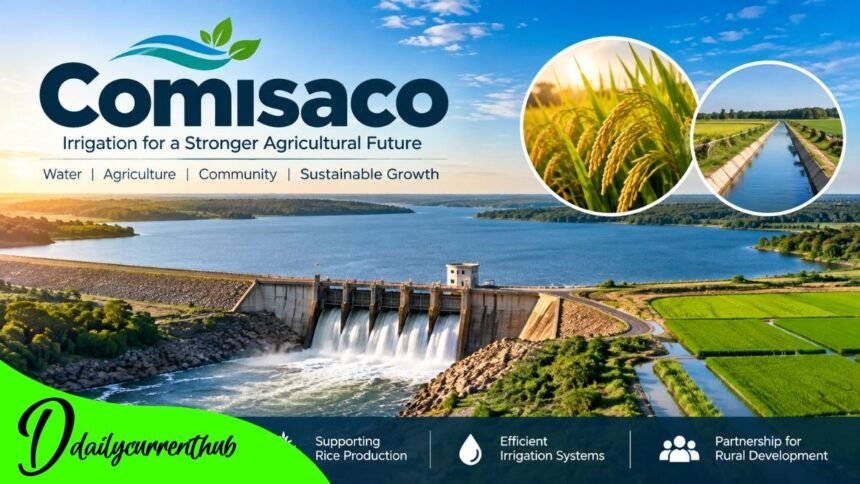
Water is one of agriculture’s most valuable resources, especially in regions where crop production depends on carefully managed irrigation. In eastern Uruguay, Comisaco S.A. has long supported rice cultivation infrastructure. The company administers the India Muerta Dam, a major irrigation facility in the department of Rocha.
Comisaco operates through a business partnership involving SAMAN S.A. and COOPAR S.A., two companies connected to Uruguay’s rice industry. Its work centers on irrigation services rather than the direct production or sale of rice.
Although the company attracts less public attention than major consumer brands, its work matters to agricultural producers who depend on reliable water supplies.
Understanding Comisaco requires looking beyond its corporate identity. Its history connects agricultural development, engineering, water management, public regulation, and the economic circumstances of rice production.
This article explores the company’s documented background, infrastructure, industry relationships, regulatory history, and continuing significance.
What Is Comisaco?
Comisaco S.A. administers the irrigation infrastructure associated with the India Muerta Dam in Uruguay. Its operational significance stems from the role of stored and distributed water in agricultural production, especially rice cultivation.
SAMAN identifies Comisaco as an associated company in which it owns a 50% interest. COOPAR also describes Comisaco as a partnership between the two businesses for managing the dam’s irrigation concession.
The company is distinct from a traditional rice mill. While its partners have connections to processing and marketing agricultural products, Comisaco’s defining Activity is providing irrigation services.
This distinction matters because an irrigation system’s economic value is not measured simply by the amount of water it stores. Water must also reach agricultural land through functioning infrastructure and within the practical requirements of crop production.
The company’s significance is therefore closely tied to the farmland, producers, and water-management arrangements that depend on the India Muerta system.
Early History and Background of Comisaco
The development of the India Muerta irrigation system belongs to a longer history of water-management projects in eastern Uruguay. The Rocha region contains extensive lowland areas where drainage, flooding, agriculture, and water storage have influenced land-use decisions for decades.
Historical records show that engineer Florencio Martínez Bula studied regional water-management possibilities in the 1930s. His proposals formed part of the early planning history that preceded the eventual construction of major hydraulic works.
The project advanced considerably during the late 1970s. A historical account published by Revista Histórica Rochense describes how national authorities, the departmental government, agricultural producers, and private companies helped develop the dam.
Comisaco emerged from cooperation between SAMAN and COOPAR to participate in the project and administer its irrigation arrangements.
A formal agreement involving the company and public authorities was signed in May 1981. Construction progressed during the early 1980s, and irrigation services began in 1982. The main dam works were provisionally received in December 1983.
These dates place Comisaco within a major period of agricultural infrastructure development in Uruguay.
The Partnership Between SAMAN and COOPAR
One of Comisaco’s defining characteristics is its relationship with two established rice-industry businesses.
SAMAN S.A. identifies itself as the owner of half of Comisaco. COOPAR S.A. likewise describes the enterprise as a joint arrangement through which the companies administer the India Muerta irrigation concession.
The partnership shows how businesses in the same agricultural sector can cooperate on infrastructure that supports production.
Rice farming requires substantial water during the growing season. Developing a dam and maintaining irrigation channels involves engineering, financing, administration, and coordination with producers.
These responsibilities are different from those involved in processing rice after harvest.
Through Comisaco, the participating companies became part of a system designed to meet an essential need earlier in the agricultural production chain.
The arrangement also raises questions about access, contractual terms, and competition. Uruguay’s public authorities have paid attention to these questions, making the company’s relationship with growers and other rice-industry businesses particularly relevant.
The India Muerta Dam and Its Infrastructure
The India Muerta Dam is located in the department of Rocha, between Velázquez and Lascano.
According to COOPAR, the reservoir has a reported useful storage volume of approximately 127.5 million cubic meters of water. Its embankment is about 3,200 meters long, with a reported clay volume of approximately 1.763 million cubic meters.
SAMAN describes an irrigation network extending more than 200 kilometers and serving approximately 10,000 hectares of rice cultivation annually.
These figures illustrate the system’s scale, although the actual irrigated area can vary with operating conditions and agricultural demand.
The dam is not merely a place where water is collected. It is part of a larger network that connects stored water to agricultural fields through canals and associated infrastructure.
In practice, reservoir storage and irrigation distribution must work together. A substantial reservoir has limited agricultural value unless water can be delivered to the land requiring it.
That relationship between storage capacity and distribution explains why canal management is as relevant as the dam itself.
Comisaco’s Role Behind the Scenes
A company responsible for irrigation infrastructure performs work that may receive little attention outside the agricultural sector.
The public record establishes Comisaco’s association with irrigation administration, while academic research describes the system’s organizational structure as involving management, technical personnel, canal workers, and administrative staff.
These activities belong to the practical operation of a large water-distribution network.
Water availability must be considered alongside the agricultural calendar, infrastructure capacity, and arrangements governing access to irrigation services.
A malfunctioning canal section, a supply interruption, or uncertainty over contractual access can become significant issues for agricultural producers.
Comisaco’s position within the India Muerta system is therefore connected to both technical management and the commercial relationships through which irrigation is provided.
Historical records also connect the company with Artigas Barrios, who later became an important political figure in Rocha. The departmental government identifies him as a former Comisaco manager before his subsequent public career.
His documented involvement is part of the company’s history, not evidence that Comisaco is a personal or family enterprise.
Supporting Farmers and Agricultural Production
Rice cultivation depends on managed water conditions, making irrigation infrastructure especially important for producers in areas served by established canal networks.
The India Muerta system was developed to support agricultural Activity in a region where water management and productive land use have long been connected.
Comisaco’s relevance to farmers lies in providing and managing irrigation services. These services help make cultivation possible across land connected to the system.
However, agricultural productivity cannot be attributed to irrigation alone.
Crop yields also depend on weather, soil conditions, seed varieties, farming practices, pests, and other production factors. An irrigation network does not guarantee a particular harvest or financial result.
The system provides essential agricultural infrastructure.
Its wider economic significance also extends beyond individual fields. Rice production involves transport, processing, machinery, agricultural services, and other commercial activities.
Comisaco should therefore be understood as one participant within a larger regional agricultural network, rather than as the sole driver of that network’s performance.
Environmental Management and Public Responsibility
Large irrigation projects can produce economic benefits while also creating difficult questions about environmental change.
The India Muerta Dam forms part of a wider history of drainage and hydraulic engineering in the wetlands of eastern Uruguay.
Academic studies of the region have examined how water-management practices changed landscapes and expanded agricultural production.
These changes cannot be assessed solely through the amount of farmland served. Environmental analysis must also consider water storage, drainage, wetlands, biodiversity, and how water moves through surrounding ecosystems.
The historical development of Rocha’s hydraulic infrastructure has therefore generated discussion about the balance between productive agriculture and ecosystem protection.
It would be inaccurate to assign every environmental consequence of regional hydraulic development directly to Comisaco. The broader transformation involved multiple projects, institutions, policy decisions, and land users.
Nevertheless, managing substantial irrigation infrastructure falls within a broader framework of responsible water-resource management and public oversight.
Public Oversight and Competition Concerns
Comisaco’s history also includes a documented competition-related complaint concerning access to irrigation services.
In 2018, Fondo de los Ajos S.A. brought a complaint against Comisaco before Uruguay’s Commission for the Promotion and Defense of Competition.
The dispute concerned irrigation access and commercial arrangements related to rice production.
Comisaco disputed the complainant’s allegations, explaining that it provided irrigation services rather than selling rice and raising questions concerning water allocations and contractual guarantees.
A water-supply agreement between the companies was subsequently concluded in November 2018.
In September 2020, the commission issued Resolution 203/020, concluding its investigation and making non-binding recommendations.
The commission recommended that authorities consider competition principles when regularizing the dam’s concession arrangements, including the possible participation of other economic operators.
It also addressed the potential effect of financial guarantees on growers’ ability to contract with rice mills other than SAMAN and COOPAR.
The resolution should not be misrepresented as a finding that every allegation against Comisaco was proved. Its recommendations addressed broader competition considerations related to the irrigation system.
The case illustrates why fair access and clear commercial arrangements matter when essential agricultural infrastructure serves multiple producers.
The Power of Infrastructure: Influence Without Publicity
Comisaco demonstrates economic significance that doesn’t depend on broad public recognition.
Most consumers encounter agricultural businesses through food brands, supermarkets, and finished products. Irrigation companies operate at an earlier and less visible stage of production.
Their contribution is associated with the physical systems that make agricultural Activity possible.
The India Muerta system provides a useful example. Its reservoir, canals, and irrigation arrangements connect engineering infrastructure with agricultural land and commercial Activity.
Public attention may increase when questions arise about service conditions, environmental effects, or concession arrangements. In other circumstances, the infrastructure itself may remain more familiar to producers than to the wider public.
This lower public profile should not be interpreted as a deliberate corporate preference for secrecy or modesty. The available evidence supports a simpler explanation: Comisaco operates in a specialized sector whose work is less visible to ordinary consumers.
Its significance is best evaluated through its documented function, infrastructure, and public responsibilities.
Legacy and Future of Comisaco
Comisaco’s historical importance is closely associated with the development and administration of the India Muerta irrigation system.
The infrastructure has supported agricultural production since the early 1980s, linking the company to decades of water management in eastern Uruguay.
Its longer-term relevance must be considered alongside agricultural needs, environmental requirements, public regulation, and the condition of the irrigation network.
Changing weather patterns and agricultural demands make water management an enduring concern, but the reviewed evidence provides no basis for announcing specific future investments or expansion plans by Comisaco.
What can be established is that irrigation remains an important part of rice production and that the India Muerta system represents a substantial piece of regional agricultural infrastructure.
The company’s legacy rests on its participation in that documented system, rather than on unverified claims about future commercial success.
Conclusion
Comisaco S.A. occupies a specialized position within Uruguay’s agricultural infrastructure. Through its association with SAMAN and COOPAR, the company has been involved in administering the India Muerta Dam irrigation system, which supports rice cultivation in the department of Rocha.
Its story reflects the relationship between agricultural production and the infrastructure that sustains it. The dam, its canals, and its water-distribution arrangements illustrate how engineering and business cooperation became part of the region’s agricultural history.
The company’s activities have also drawn public scrutiny, particularly over irrigation access and competition. These records add necessary context to any balanced account of its role.
Comisaco is neither a celebrity nor a private individual with a personal biography. Its importance is institutional, agricultural, and regional.
Understanding the company provides a clearer view of the organizations and physical systems behind a significant part of Uruguay’s rice-producing landscape.
(FAQs)
1. What is Comisaco?
Comisaco S.A. is a Uruguayan company that administers the India Muerta Dam irrigation system.
2. Where is Comisaco located?
Its principal documented activities concern the India Muerta irrigation system in Rocha, Uruguay, between Velázquez and Lascano.
3. Who owns Comisaco?
Comisaco is associated with SAMAN S.A. and COOPAR S.A. SAMAN states that it owns 50% of the company.
4. What does Comisaco do?
Its principal documented Activity is administering agricultural irrigation services connected with the India Muerta Dam.
5. When did the Comisaco irrigation system begin operating?
COOPAR reports that the irrigation service began in 1982, during the construction period of the India Muerta project.
6. How much farmland can the India Muerta irrigation system serve?
SAMAN reports that the system irrigates approximately 10,000 hectares of rice fields annually.
7. Has Comisaco been involved in regulatory proceedings?
Yes. Uruguay’s competition authority investigated a complaint about irrigation services and issued non-binding recommendations in September 2020.
8. Why is Comisaco important to Uruguay?
Comisaco manages irrigation infrastructure that supports rice cultivation in eastern Uruguay, linking water management to regional agricultural production.