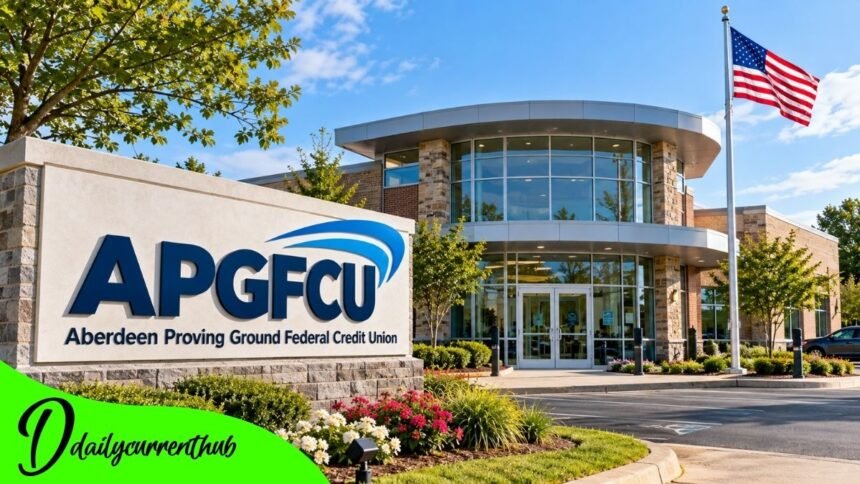
APGFCU, officially known as Aberdeen Proving Ground Federal Credit Union, is a member-owned financial institution headquartered in Edgewood, Maryland. Founded in 1938, the organization has developed from a small cooperative serving workers at Aberdeen Proving Ground into a major provider of financial services across several Maryland communities.
Its original purpose was straightforward: help individuals save money and obtain access to affordable credit. That cooperative foundation remains central to its operations, although its membership now extends far beyond the military installation where it began.
The credit union offers banking services, loans, financial education, and community programs. Its growth reflects broader trends in American cooperative finance, where member-owned financial institutions aim to combine accessible services with local participation.
This article explores the organization’s origins, membership structure, financial performance, educational initiatives, and role in supporting the communities it serves.
What Is APGFCU?
APGFCU is a federally chartered credit union providing financial services to eligible individuals and families in Maryland. Its distinguishing characteristic is its cooperative ownership structure—customers who join become members of the institution rather than simply clients of a shareholder-owned business.
The organizationorganization offers familiar financial services, including checking accounts, savings products, credit cards, vehicle financing,, and mortgages. Alongside these products, it maintains programs intended to improve financial understanding and strengthen community relationships.
Although its name reflects a military connection, the organization is not limited to active-duty personnel or defense employees. Eligibility includes people who live, work, worship, study, or volunteer in its designated service area, along with qualifying family or household members.
This combination of financial services and community membership distinguishes the institution’s present-day identity from its original, more narrowly defined purpose.
Early Life and Background: How APGFCU Started
The credit union’s roots trace back to January 1938, when employees associated with Aberdeen Proving Ground established a financial cooperative. The original organization was called Aberdeen Proving Ground Employees Federal Credit Union.
At the time, the aim was to give members a place to save and access reasonably accessible credit. Volunteers handled the institution’s operations during its earliest decades.
A significant organizationalorganizationalorganizational change occurred in 1960, when risingrising administrative demands led to the appointment of its first full-time employee, Nancy S. Stubbs, who laterlater became its first president and chief executive.
In 1967, federal approval was granted for the name Aberdeen Proving Ground Federal Credit Union.
Growth continued as membership expanded and the credit union offered additional financial services. The institution reached $1 million in assets in 1966 and $10 million in 1971.
These milestones demonstrate how a modest workplace cooperative gradually developed into a larger financial organization while retaining its original association with Maryland’s military community.
The Relationship Between APGFCU and Its Community
The relationship between the credit union and Aberdeen Proving Ground remains historically significant. However, the institution’s modern membership structure reaches substantially beyond employees of the military installation.
In 2003, it became a community-chartered credit union, recognizing its expanded role within the surrounding region.
Today, eligible individuals include people who live, work, worship, attend school or volunteer in Harford County, Cecil County, Baltimore County or Baltimore City.
Membership is also available to qualifying immediate family and household members.
To become a member, applicants must open a Share Savings account and maintain the required $5 deposit.
This eligibility structure allows the cooperative to serve a geographically connected population while preserving the membership requirements associated with credit union operations.
APGFCU’s Role Behind the Scenes: Governance and Leadership
An essential feature of the institution is its volunteer board of directors.
Unlike organizations controlled by outside shareholders, the credit union operates under a cooperative governance structure. Members elect volunteer directors who provide strategic direction, set policies, and oversee management.
Its daily operations are handled by professional employees and executives.
The organization’s 2025 annual report identified retired Colonel Donald J. Burnett as chairman of the board and Becky Smith as president and chief executive.
Governance also involves financial reporting and internal oversight. The credit union publishes annual reports that describe its financial condition, operational performance, and community activities.
Its Supervisory Committee oversees key accountability functions, including internal controls and external audit arrangements.
These mechanisms offer members a clearer view of how their cooperative is managed and how financial decisions are reviewed.
Financial Products and Services Offered by APGFCU
The institution provides financial products designed to meet different personal and household needs.
Members can access savings and checking accounts, credit cards, vehicle loans, home financing and other eligible borrowing services.
Digital banking has become an increasingly important part of these operations.
During 2025, the organization reported introducing more than 15 improvements to its digital services. These included changes to payment options, transaction processes and access to credit score information.
Homeownership is another area of activity. APGFCU offers mortgage-related products and has operated programs assisting with eligible homebuying expenses.
Its 2025 annual report recorded $1.44 million in down payment and closing cost assistance, reflecting a measurable contribution to members pursuing homeownership.
Product availability, interest rates, approval requirements, and fees depend on the particular financial service and applicable conditions.
Family Life: Supporting Young Members and Future Generations
For a financial cooperative, supporting future generations involves more than offering youth savings accounts.
APGFCU operates financial education programsprograms to help young people understand saving, spending, credit,, and responsible money management.
One notable initiative began in February 2012, when the credit union partnered with Edgewood High School’s Academy of Finance to establish a student-run branch.
Known as the Ram Branch, the project gives participating students practical experience with financial transactions, customer service and workplace responsibilities.
The organization also works with schools and educational partners to deliver financial literacy resources.
According to its 2025 annual report, its financial education activities reached 44,734 people. It also supplied financial literacy books to third- and fourth-grade classrooms in Cecil County Public Schools, reaching more than 2,200 students.
These activities demonstrate how financial education has become part of the cooperative’s broader community work.
Philanthropy and Community Engagement
Community involvement is a documented feature of APGFCU’s operations.
The institution supports nonprofit organizations, educational programs, community events, and initiatives that improve financial well-being.
Its charitable activities include donations, sponsorships, employee volunteering, and partnerships with local organizations.
The 2025 annual report recorded more than $463,000 in sponsorship contributions supporting over 324 community events.
Separately, the Community Impact Committee provided $235,000 to 35 organizations.
Education also remained a central priority. During 2025, the institution awarded $75,000 in scholarships to 30 student members.
The scholarships are part of a longstanding programprogram that supports graduating high school students and adults continuing their education.
Such initiatives provide tangible evidence of the organization’s community engagement. Their impact can be evaluated through reported participation figures, funding commitments and partnerships rather than assumptions about its motivations.
The Importance of Financial Security and Member Privacy
Financial privacy and protecting member funds are central concerns for any financial institution.
APGFCU is supervised by the National Credit Union Administration, the federal agency responsible for regulating federal credit unions.
Eligible member deposits are insured through the National Credit Union Share Insurance Fund.
The standard federal share insurance limit is generally $250,000 per member, per insured credit union, for each account ownership category, subject to the applicable rules.
This protection is different from Federal Deposit Insurance Corporation coverage, which generally applies to insured banks.
The distinction is important because consumers sometimes assume every institution offering savings accounts operates under the same insurance system.
Digital access also creates responsibilities for members, including safeguarding passwords, recognizing fraudulent communications, and protecting personal financial information.
Federal insurance protects eligible deposits under its rules; it does not eliminate every type of financial or cybersecurity risk.
Public Curiosity and Common Misconceptions About APGFCU
One persistent misunderstanding concerns who can become a member.
Because the organization’sorganization’s name refers to Aberdeen Proving Ground, some consumers assume membership is reserved exclusively for military personnel.
That is not the case.
The credit union’s membership area includes eligible civilian residents, workers, volunteers, students, and family members across its designated Maryland communities.
Another misunderstanding concerns ownership.
Although APGFCU provides services resembling those available at banks, its members collectively own the cooperative. It does not operate as a conventional, publicly traded bank.
Consumers should also distinguish between membership eligibility and automatic loan approval.
Qualifying to join does not guarantee approval for a mortgage, personal loan, or credit card. Lending decisions remain subject to the institution’s applicable underwriting criteria.
Understanding these differences helps potential members evaluate the organization accurately.
Financial Growth, Institutional Development and Future Direction
APGFCU’s expansion is visible in its published financial records.
At the end of 2025, the organizationorganization reported approximately $2.61 billion in assets, up from $2.36 billion at the end of 2024.
Membership reached 182,247 by December 2025.
The development also included adding members and certain assets from Members First of Maryland Federal Credit Union after that institution closed in August 2025.
The transaction added members and branch locations to the cooperative’s network.
By June 2026, regulatory reporting showed assets of approximately $2.69 billion and membership of 188,141.
These figures indicate continued expansion, although financial size alone should not be treated as a complete measure of member satisfaction, affordability or service quality.
Future performance will depend on how effectively the organization manages lending, technology, costs, financial risks and the needs of its growing membership.
Its published strategy emphasizes financial well-being, digital accessibility and community participation.
Conclusion
APGFCU’s development demonstrates how a financial cooperative created for a specific workplace community can evolve into a substantial regional institution.
Since its establishment in 1938, the credit union has expanded its membership, products, and branch network while remaining member-owned.
Its activities now extend beyond traditional banking services into financial education, scholarships, homeownership assistance and charitable partnerships.
The organization’sorganization’s reported financial growth offers one measure of its development, while its educational and community programsprograms reveal another.
For prospective members, the most useful approach is to evaluate current account terms, lending conditions, membership requirements and insurance protections alongside its cooperative mission.
Ultimately, APGFCU’s significance lies in its combination of historical roots, local financial services, and an ownership model in which members participate in the institution they use.
(FAQs)
1. What does APGFCU stand for?
APGFCU stands for Aberdeen Proving Ground Federal Credit Union, a federally chartered, member-owned financial cooperative based in Maryland.
2. When was APGFCU founded?
It was founded in January 1938 by employees associated with Aberdeen Proving Ground.
3. Is APGFCU only for military personnel?
No. Eligible civilians who live, work, worship, attend school, or volunteer in its designated Maryland service area may also qualify.
4. Where is APGFCU headquartered?
The institution is headquartered in Edgewood, Maryland, United States.
5. How much money is needed to become a member?
Membership requires opening a Share Savings account and maintaining a $5 deposit, subject to eligibility and account requirements.
6. Is APGFCU federally insured?
Yes. Eligible deposits are insured by the National Credit Union Administration, generally up to applicable federal insurance limits.
7. How large is APGFCU?
As of June 30, 2026, it reported approximately $2.69 billion in assets and 188,141 members.
8. Does APGFCU support education and local communities?
Yes. Its documented activities include financial education programs, scholarships, nonprofit donations, community sponsorships, and employee volunteering.