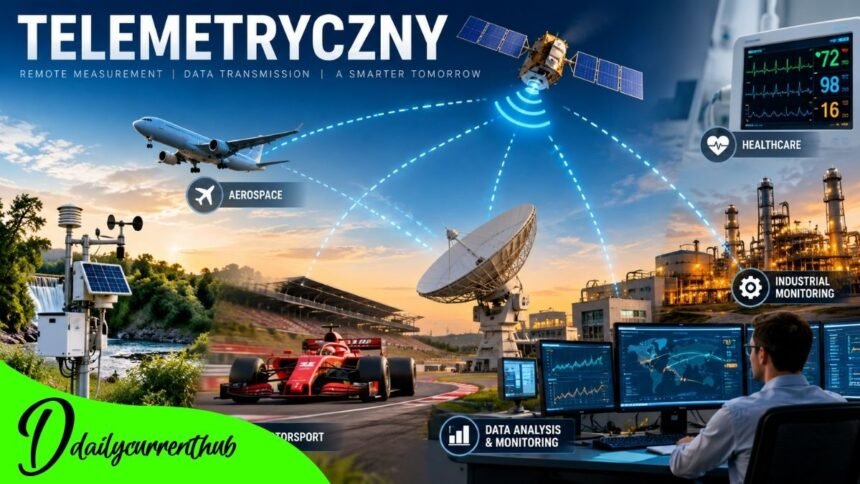
The word Telemetryczny comes from Polish technical terminology and describes something related to telemetry, the process of collecting measurements and transmitting them from one location to another. In English, its closest equivalent is telemetric. Although the term may appear unfamiliar outside Poland, the technology it describes supports essential activities in engineering, scientific research, transportation, healthcare, and digital infrastructure.
Telemetry allows engineers, researchers, and other professionals to monitor equipment or conditions without always being physically present at the measurement location. Sensors can transmit information through radio networks, satellites, cellular systems, or other communication channels before it reaches a receiving system.
From spacecraft sending engineering data to Earth to river monitoring stations reporting changing water levels, telemetric systems provide information that helps people understand conditions and make informed decisions.
This article examines the meaning, technical foundations, practical applications, benefits, limitations, and future development of telemetry-based technologies.
What Does Telemetryczny Mean?
Telemetryczny is a Polish adjective describing systems, equipment, measurements, or processes associated with telemetry. It is derived from telemetria, the Polish noun for telemetry.
In a technical context, the term commonly appears in expressions such as system telemetryczny (telemetry system) or pomiar telemetryczny (telemetric measurement).
The underlying concept is straightforward: information is measured at one location and made available elsewhere.
For example, a sensor installed near a river can measure water levels and transmit those measurements to a remote monitoring center. Engineers can review the incoming information without traveling to the sensor whenever a reading is required.
However, a telemetric system is not necessarily autonomous or continuously connected. Its capabilities depend on the equipment, network architecture, recording schedule, and intended application.
Understanding this distinction helps explain both the usefulness and limitations of remote monitoring technology.
Understanding Telemetric Technology in Detail
The Foundations of Telemetric Monitoring
Telemetric monitoring centers on three closely connected activities: measurement, communication, and interpretation.
Measurement begins with a sensor or other device that records information. Depending on the application, that information might concern temperature, pressure, electrical voltage, location, movement, or the operating condition of equipment.
The measured information is then prepared for transmission. A communication system carries the data to another device, computer, or monitoring platform.
Finally, the receiving system processes the information so it can be stored, displayed, analyzed, or used to generate alerts.
Telemetry’s usefulness comes from connecting these stages. A measurement that remains inside an inaccessible device may have limited immediate operational value. Once transmitted, the same measurement can support remote troubleshooting or a timely decision.
Reliable telemetry therefore depends not only on sensors but also on the integrity of the complete communication and processing system.
Origins and Development of Telemetry
The vocabulary surrounding telemetry reflects its central purpose: measuring something at a distance.
The Polish noun telemetria derives from Greek elements associated with distance and measurement. The Polish Academy of Sciences’ dictionary records the noun’s historical use dating to 1919, though that linguistic record should not be confused with the invention date of modern telemetry systems.
Telemetric techniques developed alongside advances in electrical measurement, radio communication, electronics, and computing.
Space exploration offers one of the clearest illustrations of their significance. Spacecraft operate far beyond direct physical access, making transmitted measurements essential for understanding their condition and scientific observations.
NASA distinguishes between scientific data gathered by instruments and engineering data describing spacecraft operating conditions.
As computing and communications expanded, the same general approach became useful in many terrestrial environments.
Today, telemetry is no longer restricted to specialized scientific equipment. Similar principles also help operators monitor connected industrial devices and distributed software systems.
How Telemetric Systems Work Behind the Scenes
A practical telemetry system contains several functional components, although their exact design varies.
First, a sensor or measuring instrument records a physical quantity or system condition. The reading may then pass to a processor that converts it into a format suitable for storage or transmission.
The communication stage moves the information towards a receiving system. Different installations may use cellular connections, radio communication, satellite links, or fixed networks.
At the destination, software can organize measurements by source and collection time. This enables users to compare readings and identify patterns.
NASA’s spacecraft documentation describes how engineering and scientific measurements are packaged into telemetry frames or packets. When immediate transmission is unavailable, spacecraft may store information until communication becomes possible.
This highlights an often-overlooked aspect of telemetry: measurement and transmission don’t always happen simultaneously.
A system may gather data continuously while forwarding it periodically. Understanding that difference is essential when interpreting dashboards described as providing real-time information.
The Role of Data Collection in Better Decision-Making
A telemetric system delivers observations, but those observations only become useful when their meaning is understood.
Consider industrial equipment that produces regular temperature readings. A single elevated reading might prompt an inspection, while a series of increasing measurements may reveal a developing operating problem.
The value comes from examining measurements in context rather than assuming that every unusual value represents a failure.
Accurate interpretation may require knowledge of sensor calibration, operating conditions, measurement intervals, and previous readings.
Time records are particularly useful because they allow analysts to establish when a measurement was collected and compare it with other events.
Incomplete or delayed information can produce misleading conclusions. Communication interruptions can create gaps, while malfunctioning sensors may report values that do not accurately reflect physical conditions.
For these reasons, good telemetry practice includes checking data quality and documenting the monitoring system’s limits.
Applications Across Different Industries
Telemetric technology serves different purposes depending on the environment in which it operates.
In aerospace, NASA uses transmitted spacecraft measurements to assess instrument performance, electrical conditions, temperature, pressure, and other operating parameters.
In environmental monitoring, the United States Geological Survey operates streamgages that measure water levels and transmit information through communication networks. These readings support water management and flood-related decisions.
In motorsport, Formula 1 teams analyze telemetry from racing cars. Vehicle sensors provide data on acceleration, braking, steering, and performance, allowing engineers and drivers to understand how a car behaves on the circuit.
Industrial facilities may use remote measurements to understand machinery conditions, while energy infrastructure can apply similar methods to monitor equipment operating in different locations.
These activities share a common objective: making measurements available to people or systems that are not located beside the instrument.
The scale, accuracy requirements, and communication methods can differ considerably.
Telemetric Technology in Healthcare and Scientific Research
Healthcare is another setting where remote monitoring can be valuable.
Connected medical devices may transmit patient measurements, so authorized healthcare professionals can review information from a different location.
The U.S. Food and Drug Administration describes remote patient monitoring as using connected devices to let healthcare providers evaluate patient vital signs remotely.
Such technology can support clinical observation, but its usefulness depends on appropriate equipment, secure communications, clinical interpretation, and professional oversight.
Telemetry does not establish a diagnosis on its own merely because a device records a measurement.
Scientific research uses comparable principles when instruments are placed in locations that are difficult or costly to visit.
Remote environmental sensors and spacecraft instruments can gather observations over extended periods, supporting research into natural and engineered systems.
Across these settings, telemetric measurement extends observational reach while leaving interpretation and responsible action to the relevant experts.
Privacy and Security in Telemetry Systems
Remote data collection creates responsibilities concerning information security and personal privacy.
A telemetry system may collect measurements that reveal equipment behavior, operational activities, locations, or potentially sensitive information about individuals.
The risks depend on what data is gathered, whether it can identify a person, where it is transmitted, and who can access it.
Communication security, device authentication, software maintenance, and access management are therefore important considerations.
The U.S. National Institute of Standards and Technology addresses these concerns in its guidance on cybersecurity requirements for Internet of Things devices.
Organizations designing telemetric systems should consider what information is genuinely required and how long it needs to be retained.
Collecting additional information does not automatically make a monitoring system more effective.
Privacy protection and operational transparency can coexist when organizations explain their data practices and implement appropriate safeguards.
Common Misconceptions About Telemetry
One widespread misunderstanding is that telemetry always involves GPS tracking. Location information is one possible telemetry output, but systems can also measure pressure, temperature, electrical performance, and numerous other conditions.
Another misconception concerns real-time monitoring.
Although some systems send information with very little delay, others transmit measurements on a schedule. A recent reading is not necessarily an instantaneous representation of current conditions.
Telemetry is also sometimes confused with remote control.
The two functions can operate together, but they are not identical. Telemetry communicates information from an observed system, while remote control involves sending instructions to change that system’s behavior.
Finally, telemetry should not be assumed to be accurate.
A sophisticated communication network cannot correct every error introduced by a faulty sensor or an unsuitable measurement method.
Recognizing these distinctions helps users evaluate technical claims more carefully.
The Future of Telemetric Technology
Continued development of connected sensors, communication networks, and data-processing software is expanding the range of activities telemetry can benefit.
One important area is software observability.
The OpenTelemetry project provides tools to collect and process software metrics, logs, and distributed traces. These records help developers understand how applications perform and behave.
This reflects a broader use of the telemetry concept: the monitored subject need not be a physical machine; it can be a complex software application.
Another direction involves combining remote measurements with automated analysis.
Such systems can identify unusual patterns or provide early warnings, but their reliability depends on the quality of the underlying data and analytical methods.
Future improvements will also need to address cybersecurity, interoperability, data management, and energy efficiency.
The central purpose remains unchanged: helping people understand distant or otherwise difficult-to-observe systems through reliable measurements.
Conclusion
Telemetryczny describes a technical concept that has become important across scientific, industrial, medical, and digital environments. Its meaning is rooted in telemetry, the practice of obtaining measurements and communicating them to another location for observation and analysis.
The value of telemetric technology lies in its ability to connect physical or digital systems with people who need to understand their condition.
NASA’s spacecraft operations, environmental monitoring networks, motorsport engineering, and software observability all demonstrate different applications of this principle.
Yet successful telemetry requires more than an internet connection or a collection of sensors. Measurement reliability, suitable transmission methods, meaningful analysis, cybersecurity, and responsible data management are equally important.
As connected technologies continue to develop, remote observation is likely to remain an essential capability for organizations managing complex systems.
Understanding what telemetry can and cannot accomplish provides a stronger foundation for evaluating its practical role in modern technology.
(FAQs)
1. What does Telemetryczny mean in English?
Telemetryczny is a Polish adjective meaning telemetric or related to telemetry. It describes equipment, measurements, or systems that collect and transmit information remotely.
2. Is Telemetryczny a person, company, or technology?
It is a technical adjective, not inherently the name of a person or organization. It is commonly used to describe telemetry-related technology and processes.
3. How does a telemetry system work?
A telemetry system collects measurements using sensors or other instruments, communicates the information through an appropriate network, and makes it available for processing, storage, or analysis.
4. Where is telemetric technology commonly used?
Applications include spacecraft operations, environmental monitoring, motorsport, industrial equipment, healthcare monitoring, and software observability.
5. Does telemetry always require an internet connection?
No. Telemetry can use radio communication, satellites, cellular networks, wired connections, or other transmission methods. A conventional internet connection is not always necessary.
6. Is telemetry the same as GPS tracking?
No. GPS can provide location information that is transmitted through telemetry, but telemetry also covers numerous other kinds of measurements and operating data.
7. What are the main risks of telemetric systems?
Potential risks include inaccurate measurements, communication interruptions, unauthorized data access, privacy concerns, and poorly maintained connected devices.
8. Why is telemetry important for modern technology?
Telemetry makes remote observation possible. It lets organizations monitor systems, assess performance, investigate problems, and make decisions using measurements gathered from different locations.