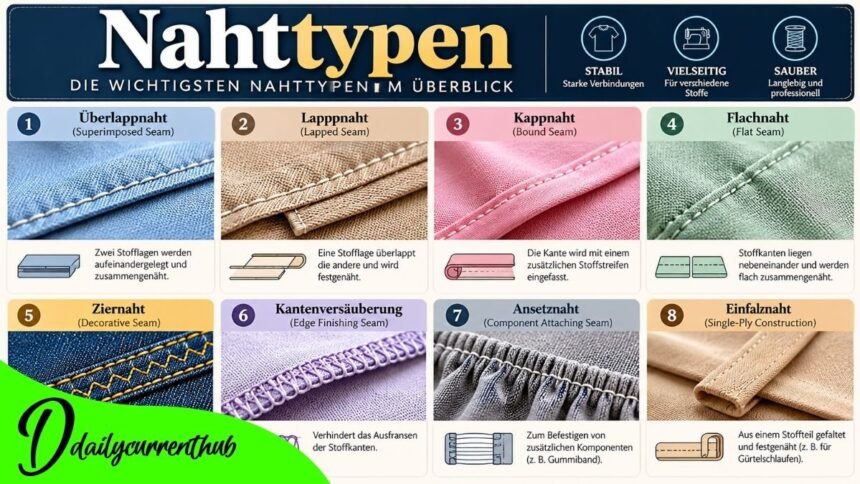
Nahttypen is the German term for seam types and describes the different methods used to join, finish, or decorate fabric and other flexible materials. Whether constructing everyday clothing, producing technical textiles, or sewing durable workwear, the seam choice can affect a finished product’s strength, comfort, appearance, and longevity.
A seam might look like a simple line of stitching, but its construction involves several decisions. The arrangement of fabric layers, stitching type, thread selection, and raw-edge treatment all affect the result.
Modern textile manufacturing uses established terminology to distinguish seam constructions. ISO 4916:1991 provides an internationally recognized classification framework, while home sewing instructions commonly use familiar names such as plain seams, French seams, and flat-felled seams.
Understanding these differences helps explain why two garments made from similar fabrics may behave differently during wear and washing.
This article explores Nahttypen, their main classifications, practical applications, sewing methods, and the factors that determine seam quality.
What Are Nahttypen?
Nahttypen describes different seam arrangements and constructions used in textile production.
A seam generally involves stitching pieces of fabric or other suitable materials together. Its construction determines how the pieces meet, overlap, fold, or remain positioned beside one another.
The term is closely related to Nahtarten, another German expression used when discussing types of seams.
Although seam construction and stitch formation are connected, they are not identical. A stitch describes how thread forms or interlocks, whereas a seam describes the overall arrangement of material and stitching.
For example, two pieces of woven fabric may be joined by a plain seam using a lockstitch. The same basic seam arrangement can be produced with other suitable stitch formations, depending on the equipment and intended application.
This distinction helps manufacturers communicate construction requirements accurately and helps home sewers choose suitable methods.
Understanding the Eight Major Seam Classes
The widely used ISO 4916 classification system identifies eight principal classes of sewn constructions. These categories distinguish how fabric components are arranged and attached.
Class 1: Superimposed Seams
Superimposed seams are among the most familiar constructions in garment manufacturing.
They form when you position two or more fabric layers together and stitch near their edges. The layers are commonly placed right sides together before sewing.
After stitching, the seam allowances may be pressed apart or toward one side.
A conventional plain seam is an example of this general construction.
Superimposed seams appear in shirts, dresses, trousers, underwear, and numerous other textile products.
Their widespread use reflects their straightforward construction and compatibility with many fabrics.
However, the exposed seam allowances of woven fabrics may require additional finishing to prevent fraying.
Class 2: Lapped Seams
Lapped seams involve overlapping fabric sections rather than simply joining their edges.
One material section extends over another, and the overlapping arrangement is secured by stitching.
Different versions can include folded edges and multiple rows of stitches.
Lapped constructions are particularly useful when a reinforced or relatively flat connection is required.
A familiar example is the felled construction used in denim garments.
The overlapping structure can help protect raw fabric edges and distribute the joining area across more than one layer.
The durability of a lapped seam depends on the fabric, thread, stitch formation, and construction, not the seam name alone.
Class 3: Bound Seams
Bound seams use an additional strip of material to enclose or secure an edge.
The binding may be made from matching fabric, contrasting fabric, or another suitable textile.
During construction, fold the strip around the edge and stitch it into place.
This method creates a controlled finish and can add decorative detail.
Bound constructions are common for necklines, garment openings, and exposed textile edges.
They are also useful when an unfinished edge would be uncomfortable or visually unsuitable.
The width, flexibility, and thickness of the binding must suit the material being sewn. Poorly matched binding can distort curved edges or create unwanted stiffness.
Class 4: Flat Seams
Flat seams are designed to join material sections while limiting bulk at the connection.
Instead of stacking substantial seam allowances, you can place fabric edges side by side and secure them with appropriate stitching.
This construction is useful when comfort and reduced thickness are priorities.
Examples include certain underwear, close-fitting knitted garments, and specialized clothing.
A flatter connection can reduce seam prominence against the body.
However, the term flat seam is sometimes used differently in everyday sewing instructions. A flat-felled seam, for example, is a distinct folded construction and should not automatically be confused with an industrial flat seam.
Class 5: Decorative and Ornamental Stitching
Not every sewn construction is primarily intended to connect separate fabric pieces.
Class 5 covers decorative stitching arrangements that create visual or structural features on material surfaces.
Examples include ornamental stitch patterns, certain forms of tucking, and decorative applications.
These techniques may introduce texture, emphasize garment details, or create contrasting lines.
Decorative stitching can also contribute to a garment’s design identity.
The chosen thread and stitch pattern influence the appearance, while fabric stability affects how accurately the design can be sewn.
Although decoration is the main objective, the stitching still needs sufficient durability for its intended use.
Class 6: Edge Finishing and Neatening
Class 6 addresses fabric edge treatment.
Many woven fabrics contain yarns that can loosen at cut edges. Suitable finishing methods reduce this tendency and improve the finished product’s appearance.
Common techniques include overedge stitching, serging, and certain hem constructions.
An overlocker is frequently used to form stitches around exposed edges.
These stitches help secure the yarns and create a tidier finish.
Edge-finishing requirements vary between fabrics. A stable material may need less treatment than a loosely woven fabric that frays readily.
For manufacturers, appropriate edge finishing contributes to garment durability and consistency.
Class 7: Attaching Separate Components
Class 7 involves attaching an additional component to the edge of a textile piece.
A typical example is securing elastic or another narrow material to a garment edge.
This arrangement is especially relevant to underwear, sportswear, and other garments that incorporate elastic components.
The attachment must accommodate the required movement and stretching of the finished product.
Using an unsuitable stitch or incorrect sewing tension may restrict elasticity or cause distortion.
Successful construction depends on coordinating the properties of the attached component with those of the main fabric.
Class 8: Single-Ply Construction
Class 8 includes constructions formed from a single piece of material.
The fabric may be folded inward along its edges and secured by stitching.
Common applications include belt loops and certain narrow fabric components.
The purpose is to create a controlled shape without necessarily joining two independent fabric pieces.
Industrial production may use specialized folding attachments to maintain consistent dimensions.
Accurate folding and stitching matter because small differences show up along narrow components.
This final class demonstrates that seam classification covers more than conventional joins between separate fabric panels.
Common Seam Types in Everyday Sewing
The eight industrial classes provide a technical framework, but home sewing instructions often use more practical names.
Plain Seam
A plain seam is one of the simplest ways to join fabric.
You usually place two pieces right sides together and stitch along a specified seam line.
You can then press the seam allowances open or to one side.
Plain seams suit many garments, including skirts, shirts, dresses, and trousers.
They are relatively straightforward to sew, but woven fabrics often require additional edge finishing.
French Seam
A French seam encloses the raw edges of fabric inside a folded seam construction.
It is commonly completed in two stitching stages.
The method produces a neat interior finish without exposing the original cut edges.
French seams are especially useful for many lightweight woven fabrics and garments where the inside finish will be visible.
They are less convenient for bulky fabrics or tightly curved areas because the extra folds can add bulk.
Flat-Felled Seam
A flat-felled seam encloses the raw edges and secures the folded construction with additional stitching.
It is widely used in denim clothing and other garments that require durable seams.
The finished construction provides a tidy appearance and helps protect raw edges from fraying.
Flat-felled seams can also be found in shirts and selected outdoor garments.
Their suitability depends on the fabric’s thickness and how easily the folds can be formed.
Overlocked Seam
An overlocked seam uses overedge stitching to join or finish fabric edges, depending on the machine setup.
Overlock machines typically trim and finish edges efficiently.
They are frequently used with knitted clothing, where suitable stitch formations can accommodate fabric movement.
However, an overlocked edge finish is not automatically the same as a complete structural joining seam.
Some garments combine overlocking with another stitching operation for the required construction.
The Difference Between Seams and Stitches
Understanding Nahttypen also requires distinguishing the seam from the stitches holding it together.
A seam describes the fabric arrangement and the resulting connection or finish.
A stitch describes how thread passes through or around the material.
Common stitch formations include:
- Lockstitch: Common in conventional sewing machines and suitable for many woven-fabric applications.
- Chainstitch: Used in various industrial sewing operations.
- Zigzag stitch: Useful for selected stretch applications and edge finishing.
- Overedge stitch: Frequently used to secure and finish fabric edges.
- Coverstitch: Often used for hems on knitted garments.
The same seam design can be produced with different stitch types, as long as the selected combination meets the construction requirements.
Choosing the Right Seam for Different Fabrics
No single seam is universally superior for every textile.
The appropriate choice depends on the fabric’s construction, thickness, elasticity, and intended use.
Lightweight woven fabrics may benefit from enclosed seam constructions that provide a neat finish without excessive bulk.
Heavier fabrics require attention to folded thickness and the sewing machine’s ability to handle multiple layers.
Knitted materials often need stitching that accommodates stretch without breaking during normal wear.
For garments exposed to repeated movement, seam strength and flexibility deserve particular consideration.
The finished product’s appearance also matters. Decorative stitching may be desirable on visible garment sections, while a discreet finish may be preferred elsewhere.
Testing a seam on a fabric sample before final construction can reveal puckering, excessive bulk, inadequate stretch, or unsuitable thread tension.
Seam Strength, Durability, and Finishing
Seam quality cannot be judged solely by how straight the stitching appears.
A well-constructed seam must also perform under the stresses expected during use.
Important considerations include seam strength, resistance to seam slippage, fabric compatibility, stitching consistency, and appropriate thread selection.
Seam slippage occurs when fabric yarns move apart near the stitching under force. It is distinct from thread breakage.
Finishing also matters. Exposed raw edges may fray during repeated washing and wear, particularly in fabrics with loose yarn structures.
Pressing the seam correctly contributes to its appearance and shape.
Industrial quality control considers both visible defects and mechanical performance, because a seam can appear attractive while still being unsuitable for its intended function.
Common Mistakes When Sewing Different Nahttypen
Several problems can affect otherwise suitable seam constructions.
Incorrect seam allowances can change garment dimensions or prevent pieces from fitting together correctly.
Poor thread tension may create puckering, uneven stitching, or loose thread loops.
Unsuitable stitch selection can restrict fabric stretch or provide inadequate support.
Failure to finish raw edges may allow woven fabrics to fray during use.
Excessive trimming can weaken a construction or make further finishing difficult.
Inaccurate pressing may leave seams bulky, distorted, or visually uneven.
Addressing these issues requires selecting appropriate materials, following pattern instructions, and checking the result before completing the garment.
Other Meanings of Nahttypen
Although Nahttypen commonly refers to textile seams, the German word Naht also appears in other technical fields.
In surgery, seam or suture techniques describe methods of closing tissue. Examples include interrupted, continuous, and intradermal sutures.
In welding, seam types describe different forms of welded joints, including butt welds and fillet welds.
These applications use different materials, equipment, and technical standards.
Consequently, the correct interpretation of Nahttypen depends on whether the discussion concerns sewing, medicine, welding, or another field.
Conclusion
Nahttypen represents a fundamental concept in textile construction, covering the different ways fabric sections can be connected, finished, and decorated.
From simple plain seams to specialized industrial constructions, each method serves a particular purpose. Some prioritize strength, others provide a smooth finish, and certain techniques emphasize flexibility or decorative appearance.
The ISO seam classification framework offers a consistent way to understand these constructions, while familiar sewing terminology helps translate technical principles into practical garment-making decisions.
Choosing the correct seam requires attention to fabric properties, stitching methods, thread selection, and expected wear.
A properly constructed seam supports not only a garment’s appearance but also its comfort and durability.
For beginners, understanding basic seam construction is an essential sewing skill. For experienced garment makers and textile professionals, familiarity with different Nahttypen provides a foundation for producing reliable, consistent, and well-finished textile products.
(FAQs)
1. What does Nahttypen mean in English?
Nahttypen is a German word meaning “seam types.” In textile construction, it refers to different methods of joining, finishing, or decorating materials through sewing.
2. How many main classes of Nahttypen exist?
ISO 4916:1991 classifies eight principal seam classes: superimposed, lapped, bound, flat, decorative, edge-finishing, component-attaching, and single-ply constructions.
3. What is the most commonly used basic seam?
The plain seam is one of the most widely used basic constructions in garment sewing because it is straightforward and works well with many fabrics.
4. What is the difference between a French seam and a plain seam?
A plain seam joins fabric with a basic line of stitching, while a French seam uses additional folding and stitching to enclose the raw fabric edges.
5. Why are flat-felled seams commonly used in jeans?
Flat-felled seams enclose raw edges and provide a durable, folded construction, making them suitable for denim garments and other applications that require reinforced joining.
6. Are seam types and stitch types the same?
No. A seam type describes how the material is arranged and joined, while a stitch type describes how the sewing thread is formed.
7. Which Nahttypen work well with stretchy fabrics?
Suitable overlocked, coverstitched, and other stretch-compatible constructions are commonly used with knitted fabrics. The best choice depends on the material and garment design.
8. Why is choosing the correct Nahttypen important?
The correct seam construction helps achieve appropriate strength, comfort, appearance, flexibility, andwear resistancer. Unsuitable construction can lead to distortion, fraying, or seam failure.