Jane Elizabeth Ebsworth Oriel was the wife of Sir David Attenborough, the celebrated British natural historian, broadcaster, and environmental advocate whose documentaries have introduced generations of viewers to the natural world. Although her husband became internationally recognized for his television career, Jane maintained a largely private life centered on her family and personal commitments.
Their marriage lasted from 1950 until Jane died in 1997, spanning nearly five decades of enormous professional change. During that period, David Attenborough developed from a young television producer into one of Britain’s most respected broadcasters.
Jane’s place in this history deserves attention beyond her identity as a famous man’s wife. Their shared family life, the challenges of his demanding career, and his later reflections on losing her offer a meaningful picture of their relationship.
This article explores Jane Elizabeth Ebsworth Oriel’s background, marriage, children, private life, and lasting significance, distinguishing documented events from interpretations that cannot be independently confirmed.
Profile Summary
| Detail | Information |
|---|---|
| Full Name | Jane Elizabeth Ebsworth Oriel |
| Also Known As | Jane Oriel, Jane Attenborough |
| Nationality | British |
| Birth Year | 1926, according to biographical records |
| Birthplace | Merthyr Tydfil, Wales, according to genealogical records |
| Age at Death | 70 years |
| Died | 1997 |
| Spouse | Sir David Attenborough |
| Marriage | 1950–1997 |
| Wedding Venue | St Anne’s Church, Kew Green, London |
| Children | Robert Attenborough and Susan Attenborough |
| Family Residence | Richmond upon Thames, London |
| Public Profile | Primarily private, with occasional photographs alongside her family |
| Philanthropic Interests | Reported involvement in charitable activities; individual organisations are not firmly documented |
| Social Media Presence | No verified personal accounts |
| Cause of Death | Brain haemorrhage |
Who Was Jane Elizabeth Ebsworth Oriel?
Jane Elizabeth Ebsworth Oriel was a British woman best known for marrying Sir David Attenborough. Their relationship began long before he achieved the international prominence associated with programs such as Life on Earth, The Living Planet, and The Trials of Life.
Married in 1950, the couple settled in Richmond upon Thames and raised two children, Robert and Susan. Jane stayed out of the professional spotlight as her husband’s career expanded through increasingly ambitious natural-history productions.
Much of the public understanding of Jane comes from David’s recollections, family photographs, and established reporting about their marriage. These sources reveal a close partnership, although they offer a less complete account of her independent interests and daily experiences.
Her significance becomes clearest in David Attenborough’s description of their relationship after her death. In his memoir Life on Air, he remembered Jane as the central emotional presence in his personal life.
Early Life and Background of Jane Elizabeth Ebsworth Oriel
Genealogical records identify Jane as having been born in Merthyr Tydfil, Wales, in 1926. Some family-history databases provide the date of July 11, 1926, although detailed contemporary documentation of her childhood is less readily established through mainstream biographical reporting.
Her early years took place during a period of considerable social change in Britain. Her generation experienced the economic difficulties of the 1930s and the disruption of the Second World War before entering adulthood in the postwar years.
That historical background provides context for Jane’s generation, but it should not be mistaken for evidence of her individual experiences. Specific accounts of her schooling, professional training, or wartime activities require stronger documentation before they can be presented as personal facts.
By 1950, Jane had joined the Attenborough family through her marriage to David. The circumstances of their first meeting are less consistently documented than their wedding and subsequent family life.
Her biography therefore has a clear documentary foundation from adulthood onwards, particularly through surviving photographs and her husband’s later recollections.
Marriage and Partnership with David Attenborough
Jane Elizabeth Ebsworth Oriel married David Attenborough in February 1950 at St Anne’s Church on Kew Green in London. Wedding photographs preserve an early moment in their relationship, with David’s older brother, actor and filmmaker Richard Attenborough, appearing alongside the couple.
At the time, David had not yet begun the BBC career that would make his name internationally famous. He was working in educational publishing before joining BBC television in 1952.
The timing matters because their marriage was established before the major professional achievements for which he is remembered.
The couple subsequently settled in Richmond upon Thames, where they built their family life. Their relationship continued throughout David’s development as a producer, television executive, wildlife presenter, and documentary filmmaker.
Publicly available photographs show Jane and David together at family occasions and formal events, offering glimpses of their shared life without revealing every aspect of their marriage.
Their partnership lasted approximately 47 years. Its personal importance is supported by David’s own later statements, rather than simply by assumptions about the private lives of celebrity couples.
The Private Life of Jane Elizabeth Ebsworth Oriel
Jane’s life differed markedly from her husband’s highly visible professional existence. While David regularly appeared on television and traveled internationally for filming, Jane rarely became the subject of extended interviews or independent media profiles.
This distinction is significant. Marrying a public figure does not necessarily make someone a public personality in their own right.
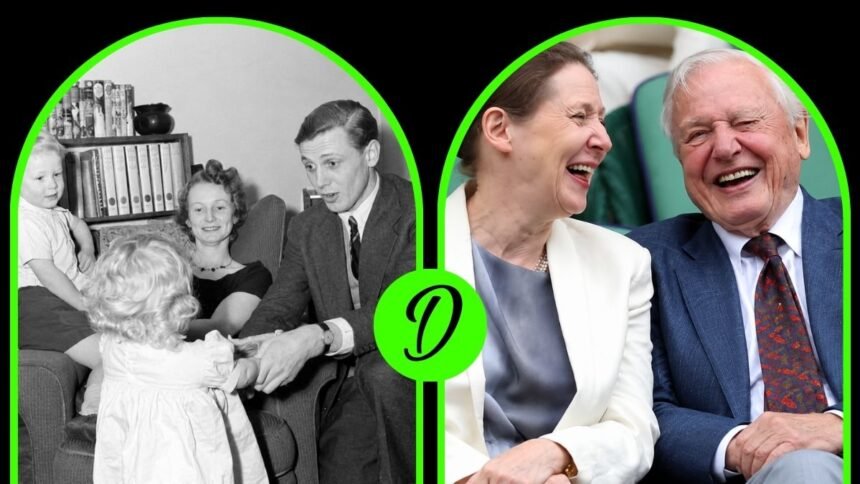
Family photographs from the 1950s offer a more personal view of the Attenborough household. For example, an image taken in December 1955 shows David and Jane with their children at home.
Such photographs demonstrate that some moments of family life entered the public record. They do not establish how Jane spent every day, nor do they reveal her private opinions or ambitions.
Descriptions of her as reserved align with her limited public profile. However, that should not automatically be interpreted as proof of a deliberate philosophy about fame. Her own explanations for staying largely out of the spotlight are not well documented.
Her privacy is best understood as a feature of the surviving historical record, rather than a personality trait that can be confidently reconstructed.
Jane Elizabeth Ebsworth Oriel’s Role Behind the Scenes
David Attenborough’s television work regularly required prolonged absences from Britain. Research expeditions and natural-history productions often required travel to remote locations for weeks or months.
These commitments challenged family life, something David himself acknowledged in later interviews.
Speaking about his children’s childhoods, he regretted the time he spent away filming. He recognized that missing several months of a young child’s development meant missing experiences that could never be repeated.
These reflections provide an important perspective on the domestic circumstances in which Jane and the children lived.
They also show why the family’s history cannot be understood exclusively through David’s documentaries and professional honors.
Nevertheless, the practical details of Jane’s responsibilities should not be overstated. Insufficient first-hand evidence supports describing her as his career manager, a collaborator in his productions, or the sole organizer of the household.
What can be established is that she remained his spouse throughout decades of demanding work and shared the family circumstances that career created.
His reflections after her death made her place in his personal life especially clear.
Family Life: Raising the Next Generation
Jane and David Attenborough had two children, Robert and Susan, both of whom pursued professional lives outside their father’s television fame.
Robert Attenborough became an academic specializing in bioanthropology, a field concerned with human biological variation, evolution, and related scientific questions.
His academic career provides an interesting connection to the scientific interests for which the wider Attenborough family is known. However, it would be speculative to attribute his professional choices directly to either parent’s influence without testimony supporting that conclusion.
Susan Attenborough worked as a primary-school headteacher before becoming involved in her father’s business affairs.
Her change of career gained particular importance after Jane’s death. David later explained that he struggled to manage parts of his affairs without his wife, and Susan stepped in to help.
In a 2016 interview, he described how Susan eventually became a partner in his small company.
The family’s experiences also appear in David’s recollections of his absences while filming. He has spoken candidly about occasions when his children teased him for missing important events.
Together, these accounts present a family history shaped by affection, professional commitments, and the practical realities of an internationally demanding career.
Philanthropy and Community Engagement
Several established media profiles describe Jane Elizabeth Ebsworth Oriel as having been involved in charitable activities. However, the publicly documented details of that involvement are relatively limited.
This distinction matters because general descriptions of charitable interests do not establish particular organizational positions, fundraising achievements, or formal philanthropic projects.
By contrast, David Attenborough has a well-documented history of environmental advocacy and support for conservation organizations.
His work has included associations with the World Land Trust, wildlife conservation initiatives, and efforts to increase public understanding of biodiversity and environmental protection.
These activities are part of David’s public professional record. They should not automatically be presented as Jane’s personal philanthropic achievements.
The couple’s shared life overlapped with the growth of modern environmental awareness, but an individual role for Jane in specific conservation campaigns cannot be established from their marriage alone.
The responsible conclusion is that reporting mentions her charitable interests, while the nature and extent of her independent contribution remain less clearly documented.
The Power of Privacy: Influence Without Publicity
Jane’s limited public presence creates an important distinction between historical visibility and personal significance.
Television programs, interviews, published memoirs, and decades of news coverage have documented David Attenborough’s life. Jane did not leave an equivalent public body of material.
This difference makes her biography more dependent on family history and others’ references.
Yet a person does not need an extensive media record to hold a meaningful place in someone else’s life.
David’s descriptions of his marriage and the effect of his wife’s death provide direct evidence of her personal importance to him.
At the same time, privacy should not be romanticised into unsupported claims about modesty, self-sacrifice, or exceptional character. Those qualities require evidence from the individual’s own words or reliable accounts of their actions.
More meaningfully, Jane’s private identity remained distinct from her husband’s public career, even as his reputation expanded around the world.
Public Curiosity and Misconceptions About Jane Elizabeth Ebsworth Oriel
Interest in Jane has continued partly because David Attenborough’s public reputation spans several generations.
Audiences who know his wildlife documentaries often become interested in his personal life, including his marriage and children.
That curiosity can produce simplified biographies that repeat a small number of established facts while introducing details that are difficult to verify.
One misconception is that Jane had no significance beyond being married to a celebrated broadcaster. David’s own recollections of their marriage contradict such a narrow interpretation of her place in his life.
Another potential misunderstanding concerns her involvement in his professional achievements. Although their marriage coincided with much of his career, that chronology does not establish that she produced programs, conducted scientific research, or participated in his filming expeditions.
Similarly, descriptions of her charitable activity should not be expanded into claims about particular organisations without supporting records.
Separating documented history from assumptions allows Jane to be remembered respectfully without manufacturing a public persona for someone whose life was primarily private.
Jane Elizabeth Ebsworth Oriel’s Death in 1997
Jane died in 1997 at the age of 70 after suffering a brain hemorrhage. Her death was a devastating personal event for David Attenborough.
At the time, he was working in New Zealand on The Life of Birds, a documentary series that would later become another major contribution to natural-history television.
After receiving news of Jane’s condition, he returned to Britain.
She was in a coma when he reached her bedside. In his memoir Life on Air, David recalled holding her hand during their final time together and feeling her squeeze it.
He later described her loss in deeply personal terms, writing that the central presence and emotional anchor of his life had gone.
His recollection matters because it offers direct testimony about their relationship rather than relying on outside interpretations.
Following her death, David continued to work and later discussed how professional activity and the natural world helped him cope with grief.
He did not remarry and continued to maintain a connection to the Richmond home they shared.
Legacy and Lasting Influence
Jane Elizabeth Ebsworth Oriel’s legacy is most clearly visible through the family she shared with David Attenborough and through his enduring memories of their marriage.
Her death did not end her place in his personal story. Years later, David continued to speak about their shared home and the memories associated with it.
In an interview quoted by People, he explained that leaving the house would also mean leaving behind the home and garden they had created together.
The statement gives unusual insight into what the marriage meant to him: not merely a chapter of his earlier life, but a lasting connection to a place and a shared history.
Their children also remained important figures in his life. Susan’s subsequent work with her father illustrates how family relationships continued to shape his circumstances after Jane’s death.
Jane should not be credited with specific scientific or broadcasting achievements that belonged to her husband. Her documented legacy is personal and familial, not an independently established television career.
That distinction makes the account more accurate, while preserving the emotional significance David himself attached to their decades together.
Conclusion
Jane Elizabeth Ebsworth Oriel occupied a deeply personal place in the life of Sir David Attenborough, one of Britain’s most influential natural-history broadcasters. Their 47-year marriage began before his television career and continued through decades of professional achievement, international travel, and family milestones.
Although Jane rarely occupied the public spotlight, the surviving record provides meaningful evidence of their partnership. Their Richmond home, their children Robert and Susan, and David’s reflections following her death all help explain her importance in his personal life.
Her story also illustrates the limits of writing about someone who gave relatively few public interviews or left few independently documented biographical details. Respecting those limits is essential to presenting her life fairly.
Jane died in 1997, but her memory remained prominent in David Attenborough’s recollections of family, home, and loss. Her legacy is best understood through their relationship and the enduring significance he attributed to their life together.
Read this too:Audrey Dunham: The Inspiring Life, Career, and Family Story of Jeff Dunham’s Wife
(FAQs)
1. Who was Jane Elizabeth Ebsworth Oriel?
Jane Elizabeth Ebsworth Oriel was Sir David Attenborough’s British wife. She married the natural historian and broadcaster in 1950 and died in 1997.
2. When did Jane Elizabeth Ebsworth Oriel marry David Attenborough?
They married in February 1950 at St Anne’s Church on Kew Green in London.
3. How many children did Jane Elizabeth Ebsworth Oriel have?
Jane and David Attenborough had two children: Robert Attenborough and Susan Attenborough.
4. What did Jane Elizabeth Ebsworth Oriel do for a living?
Jane maintained a largely private life. Although she has been associated with charitable activities in media reporting, a detailed independent professional history is not firmly established.
5. How old was Jane Elizabeth Ebsworth Oriel when she died?
She was 70 years old when she died in 1997.
6. What caused Jane Elizabeth Ebsworth Oriel’s death?
Jane died after suffering a brain hemorrhage while David Attenborough was working in New Zealand.
7. Did David Attenborough remarry after Jane’s death?
No. David Attenborough did not remarry following Jane’s death in 1997.
8. Why is Jane Elizabeth Ebsworth Oriel remembered today?
She is remembered for her long marriage to David Attenborough, their family life, and the profound personal significance he attached to their relationship in his memoirs and interviews.