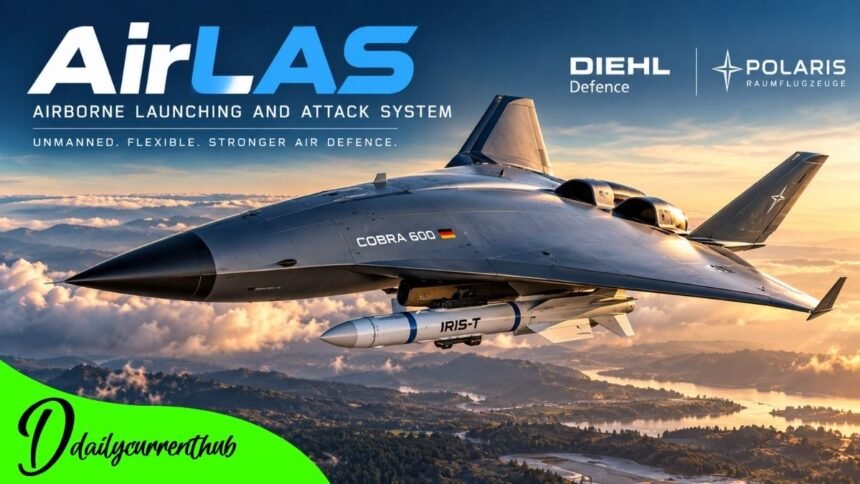
AirLAS, short for Airborne Launching and Attack System, is a German defense-development program combining unmanned aircraft technology with established guided-missile capabilities. Developed through cooperation between Diehl Defense and POLARIS Raumflugzeuge, the project explores a new approach to airborne missile deployment without requiring a pilot aboard the carrier aircraft.
The program became public on June 18, 2025, when the two companies announced an exclusive cooperation agreement at the Paris Air Show. Their objective was to integrate Diehl’s IRIS-T air-to-air missile with a POLARIS-developed unmanned carrier.
AirLAS subsequently attracted attention at ILA Berlin 2026, where the Cobra 600 aircraft was displayed carrying an IRIS-T missile. A significant development followed in August 2026, when POLARIS announced the successful first flight of its Cobra prototype.
This article examines the project’s confirmed history, participating companies, technical concept, development challenges, and prospects, distinguishing demonstrated achievements from planned capabilities.
What Is AirLAS?
AirLAS is a collaborative German aerospace and defense programdefense program based on a relatively straightforward principle: carrying an established air-to-air missile on an uncrewed aircraft.
Rather than creating a completely new missile, the developers intend to combine the IRIS-T weapon with a reusable airborne platform. The carrier would position the missile in the air before its employment, potentially expanding the area that an air-defense network can cover.
The project differs from a conventional armed drone because its publicly described purpose is not to conduct a broad range of independent surveillance and combat missions. Instead, its central role is to transport and launch a guided missile.
Diehl’s original announcement described it as an Airborne Launching and Attack System. POLARIS later referred to the same collaborative project as the Airborne Launching and Strike System.
Both descriptions relate to the German missile-carrier program associated with the Cobra aircraft.
Development and Technology Behind AirLAS
Origins and Early Development of AirLAS
The programprogram was publicly announced at the Paris Air Show in June 2025, when Diehl DefenseDefense and POLARIS formalizedformalized their exclusive cooperation.
The agreement combined two distinct areas of technical expertise. Diehl contributed expertise in guided missiles and air-defense systems, while POLARIS brought experience developing reusable uncrewed aerospace vehicles.
Their initial plan was to integrate the IRIS-T air-to-air missile with an unmanned aircraft platform.
The companies originally anticipated flight testing during 2025. However, the first publicly reported Cobra prototype flight did not occur until August 2026.
This distinction illustrates why announced development schedules should not be confused with completed technical milestones. Aerospace projects frequently require extensive design reviews, ground testing, integration work, and flight validation before they become mature operational systems.
The Diehl Defense and POLARIS Partnership
The two organizations perform complementary roles within the project.
Diehl Defense is the German defense company associated with the IRIS-T family of guided missiles and ground-based air-defense technologies. Its contribution centers on established missile technology and the wider requirements of air-defense operations.
POLARIS Raumflugzeuge is a German aerospace company whose broader work includes developing reusable spaceplane and hypersonic-flight concepts. The company has applied experience from its aerospace programs to smaller uncrewed aircraft intended for defense-related applications.
The cooperation agreement was signed by Diehl Defense CEO Helmut Rauch and POLARIS CEO Dr Alexander Kopp.
The partnership demonstrates how expertise developed for different aerospace applications can be brought together within one program. However, successful collaboration alone does not establish operational effectiveness. The resulting system must still demonstrate that its separate components work reliably together.
How the AirLAS Concept Works
At the center of the concept is an uncrewed aircraft that carries an IRIS-T missile into an airborne position.
Traditional ground-based air-defenseair-defense systems launch missiles from fixed or mobile surface positions. An airborne carrier offers an alternative by moving the missile’s launch location away from its original operating base.
The potential advantage is greater flexibility in where defensive weapons can be positioned.
At ILA Berlin 2026, a Diehl representative described the Cobra platform to Janes as an airborne launch rail, distinguishing it from more complex uncrewed combat aircraft designed around onboard sensors and multiple mission functions.
This description helps explain the program’s engineering philosophy. The developers are exploring a specialized carrier rather than trying to replicate every capability of a crewed fighter.
The system’s effectiveness would depend on reliable aircraft performance, missile integration, communication arrangements, and coordination with supporting air-defenseair-defense infrastructure.
The Cobra 600 Aircraft
Cobra 600 is the uncrewed aircraft publicly associated with the program.
The vehicle was displayed at ILA Berlin in June 2026 carrying a single IRIS-T missile. Janes described it as a delta-wing aircraft measuring about six metersmeters long.
The platform was designed around turbojet propulsion, and exhibition reports describe a four-engine configuration. The displayed example had two engines installed.
POLARIS later stated that the Cobra prototype had a take-off mass exceeding 600 kilograms.
The aircraft’s specialized configuration reflects the project’s focus on carrying a guided weapon rather than accommodating a human pilot or supporting a broad collection of onboard mission equipment.
One key distinction is between an exhibition aircraft and a fully tested weapon system. Displaying the Cobra with an IRIS-T missile demonstrated the intended configuration, but did not itself prove successful airborne missile launch or operational interception capability.
The Role of IRIS-T Missile Technology
The IRIS-T is central to the program because it provides the missile technology around which the unmanned carrier is being developed.
Diehl’s IRIS-T family includes air-to-air missiles and technologies used in ground-based air-defense systems.
For AirLAS, the publicly announced integration objective concerns the air-to-air guided missile.
The distinction matters because the different IRIS-T applications should not automatically be treated as identical systems.
Using an established missile reduces the need to develop an entirely new weapon concept from the beginning. Even so, mounting a missile on an unfamiliar aircraft adds integration and testing requirements.
Aircraft and missile compatibility, safe carriage, release behavior and communication with supporting defense systems all require careful technical validation.
The program’sprogram’s long-term prospects therefore depend not simply on IRIS-T’s reputation, but on demonstrating that the missile and Cobra carrier can function together as intended.
Key Milestones and the First Flight
The programprogram has achieved several publicly identifiable milestones.
On June 18, 2025, Diehl Defense announced its formal cooperation with POLARIS at the Paris Air Show.
From June 10 to 14, 2026, the Cobra 600 appeared at ILA Berlin, giving observers a clearer view of the project’s intended aircraft and missile arrangement.
The next significant development came in August 2026, when POLARIS announced that its Cobra prototype had completed its maiden flight.
According to the company, the aircraft traveled more than 20 kilometers during the successful test.
Contemporary reporting indicated that the first flight took place without an IRIS-T missile or equivalent external test payload installed.
That limitation is important. The flight demonstrated progress in the aircraft’s development, but it did not demonstrate a complete, operational airborne missile system.
POLARIS stated that additional flights were planned, with further integration and validation as key stages of development.
Strategic Importance for Modern Air Defense
Modern air-defense planning increasingly involves responding to aircraft, missiles and unmanned systems operating across different distances and environments.
In this setting, AirLAS offers a concept for distributing missile-launch capability beyond conventional ground-based positions.
An unmanned carrier could potentially complement existing air-defense infrastructure by carrying a defensive missile to a different location before engagement.
That does not mean it would replace conventional surface-to-air systems or crewed combat aircraft. Different platforms have different strengths, technical limitations and operational responsibilities.
The programprogram also reflects a broader trend in which defensedefense manufacturers combine existing weapons with new carrier platforms.
Its eventual value will depend on practical performance, affordability, reliability and integration with larger defense networks.
Those factors cannot be settled through theoretical advantages alone. They require evidence from testing and operational evaluation.
Challenges and Technical Limitations
The program faces several challenges common to emerging aerospace and defense systems.
The first is technical integration. A successful flight of the uncrewed aircraft does not prove it can safely and reliably carry, launch, and support the intended missile.
Another consideration is communication and coordination. A specialized carrier intended to work alongside wider air-defense infrastructure must exchange the information necessary for its assigned role.
Reliability is equally significant. DefenseDefense equipment must perform consistently under demanding operating conditions, so repeated testing is essential.
Cost is another unresolved question. The developers describe the concept as potentially affordable, but public statements about intended cost-effectiveness do not replace independently verified procurement and operating figures.
Finally, the progression from a prototype to a deployable system requires more than flight testing. It involves broader technical assessment, operational acceptance and decisions by prospective customers.
The public evidence reviewed for this article does not establish that the complete system has reached those stages.
Future Development and Potential Applications
Diehl and POLARIS have discussed several possibilities beyond the project’s initial missile-carrier concept.
Their June 2025 announcement mentioned potential integration into Europe’s Future Combat Air System (FCAS) and possible maritime applications.
The companies also identified longer-term possibilities involving other advanced aerospace and missile technologies.
These statements should be understood as proposed development directions rather than confirmed operational capabilities.
The most immediate priorities remain the Cobra aircraft’s continued flight-testing program and the validation of its intended missile-carrying role.
Future results could provide clearer evidence about the system’s reliability, engineering maturity and suitability for military requirements.
Until such testing and procurement milestones are confirmed, AirLAS is most accurately described as a developing German unmanned airborne missile-carrier concept.
Conclusion
AirLAS seeks to combine established guided-missile technology with a specializedspecialized uncrewed aircraft in a new air-defenseair-defense configuration.
Through their cooperation, Diehl Defense and POLARIS Raumflugzeuge have advanced the program from its formal announcement at the Paris Air Show in June 2025 to the public presentation of Cobra 600 at ILA Berlin 2026.
The reported first flight in August 2026 marked an additional achievement, demonstrating progress in the carrier aircraft’s development.
Yet the distinction between a successful prototype flight and a fully operational missile system remains essential.
The project’s long-term significance will depend on the results of further testing, missile integration, system reliability and potential military adoption.
For now, AirLAS is noteworthy as a genuine German defense-development program with documented progress, rather than a completed technology whose promised capabilities have all been demonstrated.
(FAQs)
1. What does AirLAS stand for?
AirLAS was originally described as the Airborne Launching and Attack System. POLARIS has also used the name Airborne Launching and Strike System.
2. Which companies are developing AirLAS?
The program is being developed jointly by German companies Diehl Defense and POLARIS Raumflugzeuge.
3. What is the main purpose of AirLAS?
Its primary purpose is to explore using an uncrewed aircraft as a carrier and launch platform for the IRIS-T air-to-air missile.
4. What is the Cobra 600?
Cobra 600 is the uncrewed aircraft associated with the program. It was publicly displayed carrying an IRIS-T missile at ILA Berlin in June 2026.
5. When was AirLAS first announced?
The formal cooperation agreement was announced on June 18, 2025, during the Paris Air Show.
6. Has the AirLAS aircraft completed its first flight?
Yes. POLARIS announced a successful Cobra prototype flight in August 2026, reporting a distance of more than 20 kilometers.
7. Is AirLAS currently an operational military system?
The reviewed public evidence establishes prototype development and flight testing, but does not confirm that the complete system has entered operational military service.
8. What is the future of AirLAS?
Its future depends on continued aircraft testing, successful missile integration, technical evaluation, and decisions about possible military adoption.