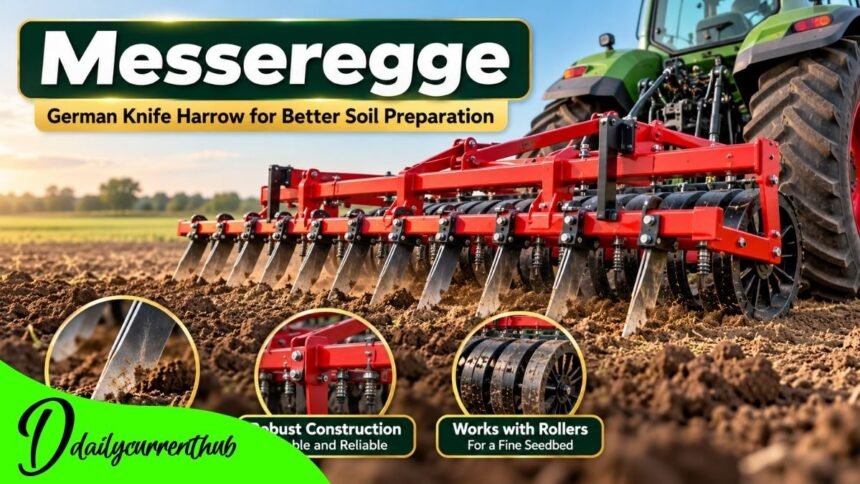
Messeregge is a specialized German agricultural term describing a knife-equipped harrow used in soil preparation. Although many English-speaking readers may be unfamiliar with it, the equipment has a documented place in modern farming machinery. Its purpose is closely connected with breaking soil clods, preparing the surface of cultivated land, and supporting seedbed preparation before planting.
Agricultural equipment manufacturers, including Kerner Maschinenbau and Fliegl Agro-Center, use the term in their technical documentation and product descriptions. Their records establish that Messeregge refers to a physical agricultural implement rather than an internet trend or an invented digital communication system.
The equipment typically works with other soil-preparation machinery, particularly front-mounted roller systems. Its blade-shaped components interact with the upper soil layer, helping manage larger clods before subsequent finishing operations.
Understanding this agricultural tool requires looking beyond its unusual name. Its construction, working characteristics, machinery compatibility, and limitations all influence how it performs in the field.
This article explores the meaning of Messeregge, its agricultural background, construction, operation, documented models, practical benefits, maintenance, and role in modern soil preparation.
What Is Messeregge?
Messeregge is a knife-equipped agricultural harrow designed to work the upper soil layer and break larger soil clods. It can form part of a broader cultivation system that combines several soil-preparation operations.
The name connects two German words: Messer, meaning knife, and Egge, meaning harrow. This construction reflects the equipment’s principal working elements.
Unlike a conventional harrow that may rely on spring tines or rotating discs, a Messeregge uses knife-shaped components arranged across a supporting frame.
Its configuration varies by manufacturer. Some units are supplied as accessories for existing agricultural rollers, while others appear as selectable working tools within larger equipment systems.
One documented example is the Kerner TORON front packer, which accommodates a Messeregge as a front working attachment. Fliegl also markets a front-mounted Messeregge for use with its Profiwalze equipment.
These examples demonstrate that the term has a clear technical application within agricultural machinery.
Meaning and Agricultural Background of Messeregge
The origins of Messeregge are best understood through German agricultural vocabulary rather than speculative internet definitions.
German uses compound nouns extensively, combining descriptive words to identify tools, machinery, and technical functions. In this case, Messer and Egge combine to describe a harrow equipped with knife-like working elements.
A conventional Egge is an agricultural implement associated with shallow soil loosening, crumbling, and weed management. Adding knife-shaped components creates a more specific category of soil-working equipment.
The agricultural meaning is supported by manufacturer records rather than linguistic interpretation alone.
Kerner’s documented parts specifications from 2021 identify a Messeregge assembly, including right-hand knives, straight knives, left-hand knives, and supporting frames. The underlying engineering drawing is dated 2015.
This confirms that the term was already used in machinery documentation before its appearance in numerous recent explanatory articles.
However, these records do not establish the exact date when the implement was first invented. Its history should therefore be distinguished from the longer development of harrows and mechanized soil cultivation generally.
Construction and Main Working Components
A Messeregge is built from an assembly of soil-engaging components secured to a supporting structure.
The main elements are metal knives, a mounting frame, fastening hardware, and adjustment mechanisms, depending on the model.
Kerner’s Frontpacker 300 parts documentation provides a particularly useful example. Its Messeregge assembly includes ten right-hand knives, four straight knives, and ten left-hand knives.
The same assembly specifies a three-meter frame and associated mounting components.
These different knife configurations illustrate how an agricultural manufacturer organizes working elements across the width of an implement.
Their arrangement is intended to provide contact with the soil as the tractor moves forward.
The exact blade geometry, mounting configuration, and wear resistance depend on the machinery design. It would be inaccurate to assume every Messeregge has the same number of knives or uses the same replacement parts.
Compatibility with the supporting roller or packer system is equally important because the front attachment must operate correctly within the complete machine.
How Does Messeregge Work?
A Messeregge works through the mechanical interaction between its knife-shaped elements and the soil surface.
As the tractor advances, the working parts contact and disturb soil clods. The aim is to break larger formations into smaller material that can be processed more effectively during subsequent cultivation.
The implement is particularly relevant where a front-mounted tool operates ahead of an agricultural roller.
In this arrangement, the knife harrow performs preliminary soil-breaking, while the roller provides additional crumbling, leveling, or reconsolidation, depending on its design.
The process can combine several preparation stages during a single field pass.
Working depth is an important operating variable. Kerner’s 2026 TORON documentation specifies a working-depth range of 0–10 centimeters for its Messeregge configuration.
That specification applies to the documented Kerner equipment, not every knife harrow.
Actual operating results depend on the soil’s moisture, texture, compaction, surface condition, and the selected machinery settings.
The operator must therefore adjust the equipment according to the field rather than assume one setting will suit every situation.
Importance of Messeregge in Seedbed Preparation
Seedbed preparation is one of the principal agricultural contexts in which a Messeregge can be useful.
Before sowing, farmers often need to manage the surface condition of cultivated land. Large soil clods and uneven areas can disrupt the creation of a consistent planting environment.
A knife harrow helps address part of this problem by mechanically breaking surface clods.
Combined with a suitable roller, it can help create a more even soil surface ahead of planting machinery.
The broader objective is to prepare soil conditions suitable for the selected crop and sowing method.
However, seedbed quality cannot be judged by surface appearance alone. Soil moisture, structure, drainage, and compaction risk all influence whether additional cultivation is appropriate.
Working soil when it is excessively wet can cause smearing or structural damage. Excessively dry, hard soil may be difficult to break efficiently.
A Messeregge should therefore be treated as one component of a considered cultivation process, not as a universal solution for every field.
Messeregge in Kerner Agricultural Equipment
Kerner Maschinenbau provides one of the clearest documented examples of Messeregge technology.
Its TORON front packer is designed to combine soil preparation with roller-based operations.
The manufacturer’s 2026 product literature identifies three working widths: 2.5 meters, 3.0 meters, and 3.5 meters.
For these configurations, the technical specifications list 20, 24, and 28 working elements respectively for the Messeregge option.
The documented spacing is 125 millimeters, with a working-depth range of 0–10 centimeters.
Kerner also offers alternative front tools, including a spring-tine harrow, allowing operators to select equipment according to their intended field operations.
The TORON system combines adjustable front tools with a roller assembly designed for crumbling and reconsolidation.
Optional hydraulic depth adjustment provides another configuration choice.
These details show why a Messeregge is frequently discussed as part of a larger machine rather than as an entirely separate agricultural vehicle.
Fliegl Messeregge and Front-Mounted Applications
Fliegl Agro-Center supplies another documented example of this agricultural attachment.
Its product catalog includes a 2,600-millimeter Messeregge intended for front mounting in conjunction with Profiwalze equipment.
The manufacturer describes its purpose as breaking larger soil clods.
The listed implement weighs 200 kilograms and is identified as an accessory within the company’s soil-cultivation equipment range.
This example is useful because it shows the term’s practical commercial application.
Farmers considering such equipment must distinguish between purchasing an individual attachment and acquiring an entire roller combination.
A compatible roller, mounting system, and tractor arrangement may be necessary for the intended installation.
Equipment dimensions and product compatibility should always be confirmed against the manufacturer’s current specifications rather than inferred from the name alone.
Benefits and Practical Advantages of Messeregge
The principal advantage of a Messeregge is its contribution to controlled soil preparation.
Its knife-shaped working elements are intended to break soil clods, while associated machinery can support further surface finishing.
Potential practical advantages include clod reduction, improved preparation before rolling, and integration into combined cultivation operations.
Combining compatible working tools may reduce the need for separate passes in some field operations, although the actual outcome depends on the equipment and cultivation plan.
A front-mounted configuration can also allow a tractor to perform one soil-preparation task ahead of another implement.
Nevertheless, a Messeregge does not automatically improve crop yields, reduce fuel consumption, or protect soil structure.
Such results require field-specific evidence and comparison with alternative methods.
The greatest practical value comes from selecting the equipment for a clearly identified agricultural need.
Messeregge Compared With Other Agricultural Harrows
The term Messeregge should not be used interchangeably with every type of harrow.
A spring-tine harrow uses flexible tines that interact with the soil through their shape and movement.
A disc harrow uses rotating discs that cut and disturb soil as the implement travels forward.
A Messeregge, by contrast, is identified by its knife-shaped soil-working components.
These differences can influence how the equipment handles clods, crop residue, and surface conditions.
However, no single harrow type is automatically superior in every situation.
A farmer’s decision should reflect the required working depth, soil condition, tractor capability, and the existing cultivation system.
Comparisons are more useful when they focus on specific equipment models and documented performance rather than broad marketing claims.
Maintenance and Safe Operation
Like other soil-engaging agricultural equipment, a Messeregge requires inspection and maintenance.
Its working elements experience direct contact with soil, stones, and other field material. Wear and damage can affect their performance over time.
Operators should examine knives, mounting points, fasteners, adjustment mechanisms, and the supporting frame according to the manufacturer’s instructions.
Damaged components should be replaced with parts specified for the relevant equipment model.
Regular cleaning can also help identify problems that may otherwise remain hidden beneath accumulated soil and plant material.
Safety is especially important during attachment, adjustment, and maintenance.
Heavy agricultural equipment must be properly supported before anyone works beneath it. Tractor movement, stored hydraulic pressure, and unsupported raised machinery can create serious hazards.
The applicable operating manual remains the authoritative guide for safe use and servicing.
Common Misconceptions About Messeregge
The unusual spelling of Messeregge has produced several conflicting online explanations.
Some websites describe it as a digital communication concept, a branding expression, or an exhibition-related term.
Those interpretations should not be presented as established definitions without supporting evidence.
The agricultural meaning is better documented because it appears in manufacturer catalogs, technical drawings, and replacement-parts records.
Another misconception is that every Messeregge represents the same machine.
In practice, manufacturers can use the term for equipment with different widths, assemblies, and installation arrangements.
It is also misleading to describe the tool as an agricultural breakthrough that guarantees better harvests.
A Messeregge is a specialized implement with a defined mechanical function. Its effectiveness depends on how appropriately it is selected and operated.
The Future of Messeregge in Modern Agriculture
The future relevance of knife-harrow equipment is connected to the continuing need for effective soil preparation.
Farmers increasingly evaluate field operations by cost, machinery compatibility, soil condition, and the number of cultivation passes required.
Adjustable tools and integrated implement combinations let farmers configure agricultural machinery for different tasks.
The Kerner TORON demonstrates this approach through its selection of working attachments and optional depth adjustment.
Future developments in agricultural machinery may influence the design and application of such equipment, but specific innovations should not be attributed to Messeregge without manufacturer confirmation.
Its continuing value will depend on practical performance, maintenance requirements, and suitability for changing cultivation methods.
Rather than representing a mysterious new technology, Messeregge illustrates how established mechanical principles remain relevant within modern farm-equipment systems.
Conclusion
Messeregge is a documented German agricultural implement associated with knife-shaped working elements and shallow soil preparation. Its principal function is to help break larger soil clods, particularly when used alongside compatible front-mounted roller equipment.
Technical documents from Kerner Maschinenbau and product specifications from Fliegl Agro-Center provide clear evidence of its construction and agricultural applications.
Although the term has attracted conflicting explanations online, the machinery-based meaning is supported by identifiable components, working dimensions, and manufacturer documentation.
Its practical usefulness depends on more than the presence of cutting elements. Soil moisture, surface conditions, adjustment settings, machinery compatibility, and maintenance all influence its performance.
For farmers and agricultural equipment buyers, understanding these considerations is more valuable than accepting generalized promises of improved productivity.
Messeregge remains a useful example of specialized soil-working equipment whose effectiveness is determined by appropriate selection, careful operation, and sound agricultural practice.
(FAQs)
1. What does Messeregge mean in English?
Messeregge means knife harrow or knife-equipped harrow. It is a German agricultural term combining words associated with knives and harrowing equipment.
2. What is Messeregge used for?
It is used for shallow soil preparation, particularly breaking larger soil clods and supporting seedbed preparation when combined with suitable equipment.
3. Is Messeregge a real agricultural machine?
Yes. Kerner Maschinenbau identifies Messeregge in technical machinery documentation, and Fliegl Agro-Center lists a front-mounted implement under that name.
4. How does a Messeregge work?
Its knife-shaped working elements contact and disturb soil as the tractor moves forward, helping break clods ahead of subsequent cultivation or rolling operations.
5. Which manufacturers offer Messeregge equipment?
Documented suppliers include Kerner Maschinenbau and Fliegl Agro-Center, although their equipment configurations differ.
6. Is Messeregge the same as a disc harrow?
No. A Messeregge uses knife-shaped working parts, while a disc harrow uses rotating discs to work the soil.
7. Does Messeregge improve crop production?
It can contribute to seedbed preparation, but improved crop yields are not guaranteed. Results depend on soil conditions, management practices, and other agricultural factors.
8. What should farmers consider before buying a Messeregge?
Farmers should review working width, tractor compatibility, soil conditions, adjustment options, replacement-parts availability, and whether the implement fits their existing machinery system.